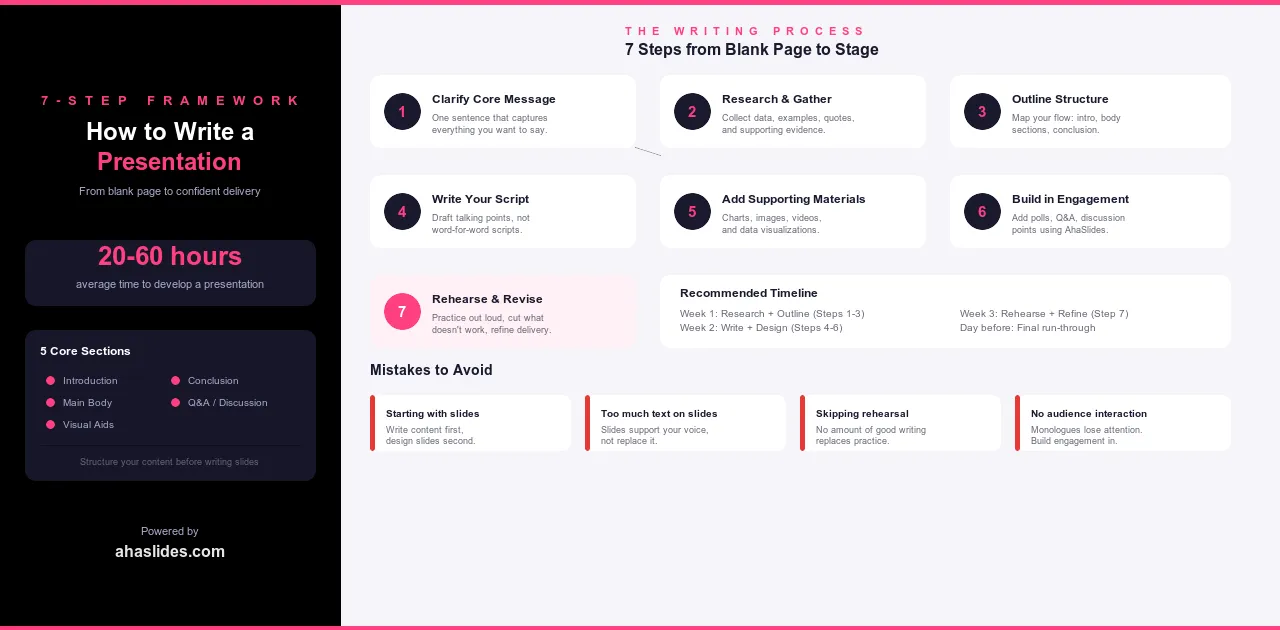


How to Write a Presentation: Complete Guide With Examples

部落格縮圖

Writing a presentation differs from writing an essay or article. Your audience is listening, not reading. They can't go back and reread a confusing sentence. They can't control the pacing.

Effective presentation writing means you have to guide your audience through ideas step-by-step, signal transitions clearly, and keep language simple. You're scripting a journey, not just listing information.

The challenge of presentation writing

In writing, readers can absorb complexity. They can pause and think. They re-read difficult passages.

In presentations, your audience hears your words once. If they don't understand a point, they can't ask you to repeat it mid-flow. Your language has to work the first time.

This means: simpler words, shorter sentences, clearer structure.

Before you write: Create an 概要

Never write a presentation without an outline. Your 概要 is the architecture. Your script is the finishing work.

Outlining forces you to decide:

  • What is your core message?
  • What are your 3-5 main points?
  • What evidence supports each point?
  • How do you transition between ideas?
  • What's your call to action?

An outline prevents rambling. It keeps you on track during the actual presentation.

How to structure your script

Unlike essays, presentations have a clear rhythm:

1. 介紹

Open with a hook: a question, a surprising statistic, or a relevant story. Your audience decides in the first 30 seconds whether they're paying attention.

Then signal your direction: "Today we're covering three ways to reduce project timelines." Your audience now knows what to expect.

2. Body content

Each of your main points gets its own section. Within each section:

  • State the point clearly
  • Provide evidence or examples
  • Explain why it matters to your audience
  • Transition to the next point

Different presentation types require different body 結構. A sales pitch organizes differently than a training session.

3. Supporting details

Each main point needs evidence. That evidence comes in different forms: data, customer testimonials, case studies, personal anecdotes, or visual examples.

Choose evidence that matches your audience. Technical audiences want data. Emotional audiences want stories. Most audiences want both.

4. 過渡

These are crucial and often forgotten. Write them explicitly: "Now that we've covered why this matters, let's look at how to implement it." Transitions tell your audience you're moving to a new idea and often signal why that move makes sense.

5. 結論

Restate your core message. Remind your audience what you've covered and why it matters. End with a clear call to action: what do you want them to do with this information?

Five principles of presentation writing

1. Write for the ear, not the eye

Read your script aloud. Phrases that look fine on paper sound awkward when spoken. Sentences that work in writing are too long for listening.

Example: "Considering the aforementioned implications" sounds pretentious aloud. "This changes how we approach the problem" is clearer when heard.

Your script should sound natural. It should sound like you talking, not like a formal document.

2. Repeat key ideas

In writing, repetition feels like bad style. In presentations, it's good technique. Your audience hears your words once. If you want them to remember something, say it more than once.

Pattern: Introduce an idea, develop it with examples, recap it at the end. "I want to emphasize three things. Here are the three things. Let me reiterate why these three things matter."

3. Use numbers carefully

Numbers in presentations require special attention. Your audience can't pause to process "We increased efficiency by 27.3%." They need context or they'll forget it.

Better: "We increased efficiency by more than a quarter" or "We cut the time required almost in half." Or give a concrete example: "What used to take 10 days now takes 2."

4. Signal structure explicitly

Audiences need signposts. "We'll cover three areas today" tells them what to expect. "First...second...third" tells them where they are. "That covers the problems. Now let's look at solutions" tells them you're shifting topics.

These signposts seem obvious when you write them. But they're essential for audiences who can't go back and reread.

5. Build in delivery moments

Your script should indicate where you pause, where you ask questions, where you let information sink in. If you're using interactive tools like polls, note where they go.

A script that's just words fails. A script that marks pauses, questions, and interactive moments guides your 交貨.

The 5 core sections of every presentation

1. 介紹

Your presentation's length determines how much time you spend here. A 5-minute presentation spends 30-45 seconds on intro. A 45-minute training spends 5-10 minutes.

As a rule: shorter presentations need stronger intros (you have to grab attention fast), longer presentations need more context (people need time to settle in).

2. Context or problem statement

Why does this matter? What problem are we solving? What opportunity are we pursuing?

Your audience won't care about your solution until they understand the problem. Spend time here.

3. Your main ideas or solution

Now that they understand the context, present your core message. This is the meat of your presentation. Here's where your 3-5 main points live.

4. Evidence and supporting details

Why should your audience believe you? What proof supports your ideas? This might be data, case studies, testimonials, or examples.

5. 結論與行動號召

Summarize what you've covered. Remind them why it matters. Tell them exactly what you want them to do with this information: adopt a policy, try a technique, schedule a meeting, or simply think differently about a topic.

Different presentation types need different pacing

A long presentation needs more supporting details. A 15-minute talk needs different proportions than a 45-minute training. Your opening statement in a sales pitch differs from your opening in an educational session.

The same core sections appear in all presentations. The proportion and emphasis differ.

From script to delivery

Once you've written your script, you're not done. You need to practice.

Read it aloud multiple times. Notice where you rush, where you stumble, where you lose the thread. Edit for clarity when you find those spots.

Mark your script with delivery notes: pause here, look at the audience here, emphasize this phrase. These notes make a difference between a script that's just written and one that's been 交付.

The best presentation scripts balance being conversational (so they sound natural when spoken) with being structured (so they guide your audience through ideas logically).

How presentation writing connects to 互動 分子

If you're including polls, Q&A sessions, or other interactive features, write them into your script. Don't leave them as afterthoughts.

"Let me pause here and get your input on something" signals a shift from lecture to interaction. It brings your audience from passive listening to active participation.

The transition from lecture to interaction requires deliberate writing. Your script should show where these moments happen and why they matter for your message.

結語

Presentation writing is different from other kinds of writing. Your audience hears it once, can't replay it, and needs clear structure to follow along.

Start with an outline. Write your script for the ear. Build in transitions that signal shifts. Include evidence that supports your ideas. End with clarity about what you want your audience to do.

The result is a presentation that educates, engages, and drives action.

訂閱即可獲得提升觀眾參與度的技巧、見解和策略。
謝謝! 您的提交已收到!
糟糕! 提交表格時出了點問題。

查看其他帖子

AhaSlides 已被福布斯美國 500 大企業所採用。立即體驗互動的力量。

了解更多
© 2026 AhaSlides 私人有限公司