



Most teachers begin course planning with a question like: what content do I need to cover? Outcome based education asks a different one: what should students be able to do when this is over?
That shift, from content delivery to demonstrated competence, is the core of OBE. It sounds like a subtle reframe, but it changes the entire design of a course: what you teach, how you assess it, and what you count as success.
This guide covers what outcome based education is, the principles behind it, how it differs from traditional teaching, and practical tools for making it work in your classroom.
What is outcome based education?
Outcome based education (OBE) is a teaching and curriculum design approach where all decisions flow from pre-defined learning outcomes. The outcomes come first. Everything else, lesson design, assessments, activities, is built backward from them.
William Spady, who formalized OBE in the 1990s, defined outcomes as "high-quality, culminating demonstrations of significant learning in context." [1] The key word is demonstrations: the goal is not to cover a syllabus but to ensure every learner exits with a specific, verifiable capability.
OBE emerged from dissatisfaction with traditional models that treated content delivery as the end goal, regardless of whether students actually learned. It spread through Australia, South Africa, Hong Kong, and the United States and is now embedded in accreditation frameworks for engineering, medicine, nursing, and teacher education worldwide.
OBE vs. traditional education
The difference between OBE and traditional education is most visible in what drives decisions:
| Aspect | Outcome based education | Traditional education |
|---|---|---|
| Starting point | Define outcomes first | Define content first |
| Student role | Active: demonstrates competence | Passive: absorbs content |
| Assessment | Performance-based, ongoing | End-of-term exams |
| Teaching flexibility | Methods adapt to reach outcomes | Fixed curriculum sequence |
| Measure of success | Can the student perform the skill? | Did the student pass the test? |
| Adaptability | Adjusts to industry and real-world needs | Centers established knowledge |
In traditional education, a course ends when the content is covered. In OBE, a course ends when students can demonstrate the stated outcome, not before.
The 4 principles of OBE
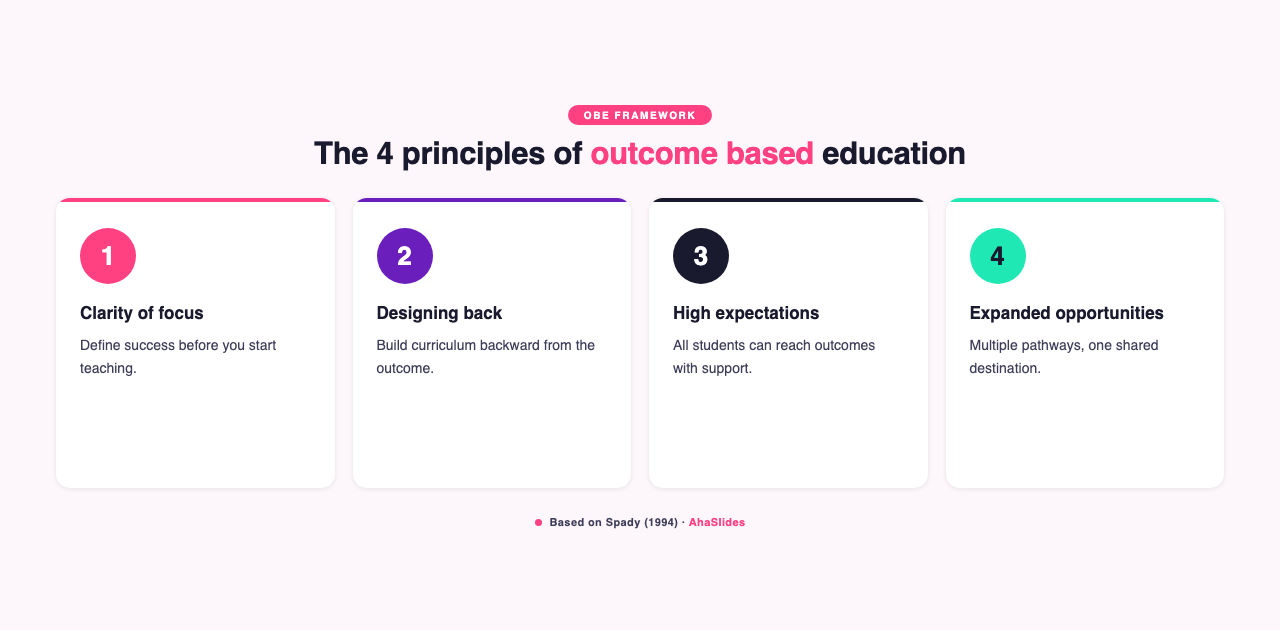
William Spady [1] (1994) identified four design principles that underpin every effective OBE system. These are not abstract ideals; they are practical design rules that shape every decision in an OBE-aligned course.
1. Clarity of focus
Every course element, lessons, assessments, group activities, and materials, explicitly ties back to the stated outcomes. Both teachers and students know exactly what success looks like before the unit begins.
This eliminates the experience of reaching the end of a semester and asking whether learners are actually prepared for what comes next. The answer is built into the design.
2. Designing back
Educators identify desired exit outcomes first, then work backward to design the curriculum. If the outcome is "students can analyze financial statements," the content, practice activities, and assessments are all chosen because they build to that specific skill. Theory that does not serve the outcome does not make the cut.
3. High expectations
OBE assumes every student can reach the outcomes with appropriate support and time. The role of teaching is not to rank learners on a bell curve but to get everyone to demonstrated competence. Failure is treated as a signal to adjust instruction or support, not as evidence of a fixed outcome distribution.
4. Expanded opportunities
Because the target is outcome attainment, not time-in-seat, OBE allows for flexible learning pathways. Different students can reach the same outcome through different routes, at different paces, or through different activities, provided they can demonstrate the result in the end.
OBE example: a digital marketing course
The clearest way to see OBE in practice is to compare two versions of the same course.
Traditional version: "Introduction to Digital Marketing: covers advertising platforms, SEO fundamentals, analytics concepts, and social media theory." Assessment: a final written exam.
OBE version: The course defines three exit outcomes:
- Students can create and optimize a paid online advertisement
- Students can analyze web traffic data and draw conclusions
- Students can develop a content strategy for a specific audience
Assessment is a live campaign. Students build one, run it, analyze the results, and present recommendations. The grade is based on demonstrated capability, not recall of marketing vocabulary.
The same logic applies across disciplines. A medical training program built around "student accurately reads a chest X-ray" has a different curriculum than one that covers "radiology theory." A language course designed around "student holds a 10-minute conversation with a native speaker" looks nothing like a grammar-drill syllabus.

Levels of outcomes in OBE
OBE systems operate across multiple levels, each building on the one below:
Course Outcomes (COs): The specific capabilities a student gains from a single course. These are the most granular level and the ones most visible to students day-to-day.
Program Outcomes (POs): The cumulative competencies a student has after completing a full degree or certification program. These represent accumulated capability across all courses.
Program Educational Objectives (PEOs): The broader professional or life capabilities the program prepares graduates for. These are typically defined with input from employers, accrediting bodies, and industry partners.
The chain runs in both directions. Individual lessons feed into course outcomes. Course outcomes stack into program outcomes. Program outcomes prepare graduates for PEOs that reflect real-world performance standards.
How to check outcomes in real time
The gap between defining outcomes and confirming students have reached them is where OBE most often loses ground. Written assessments at the end of a unit tell you what happened in the past. What you need are live checks during instruction so you can adjust before it is too late.
Interactive tools like AhaSlides let teachers run real-time outcome checks at any point in a lesson, without disrupting the flow or requiring extra setup.
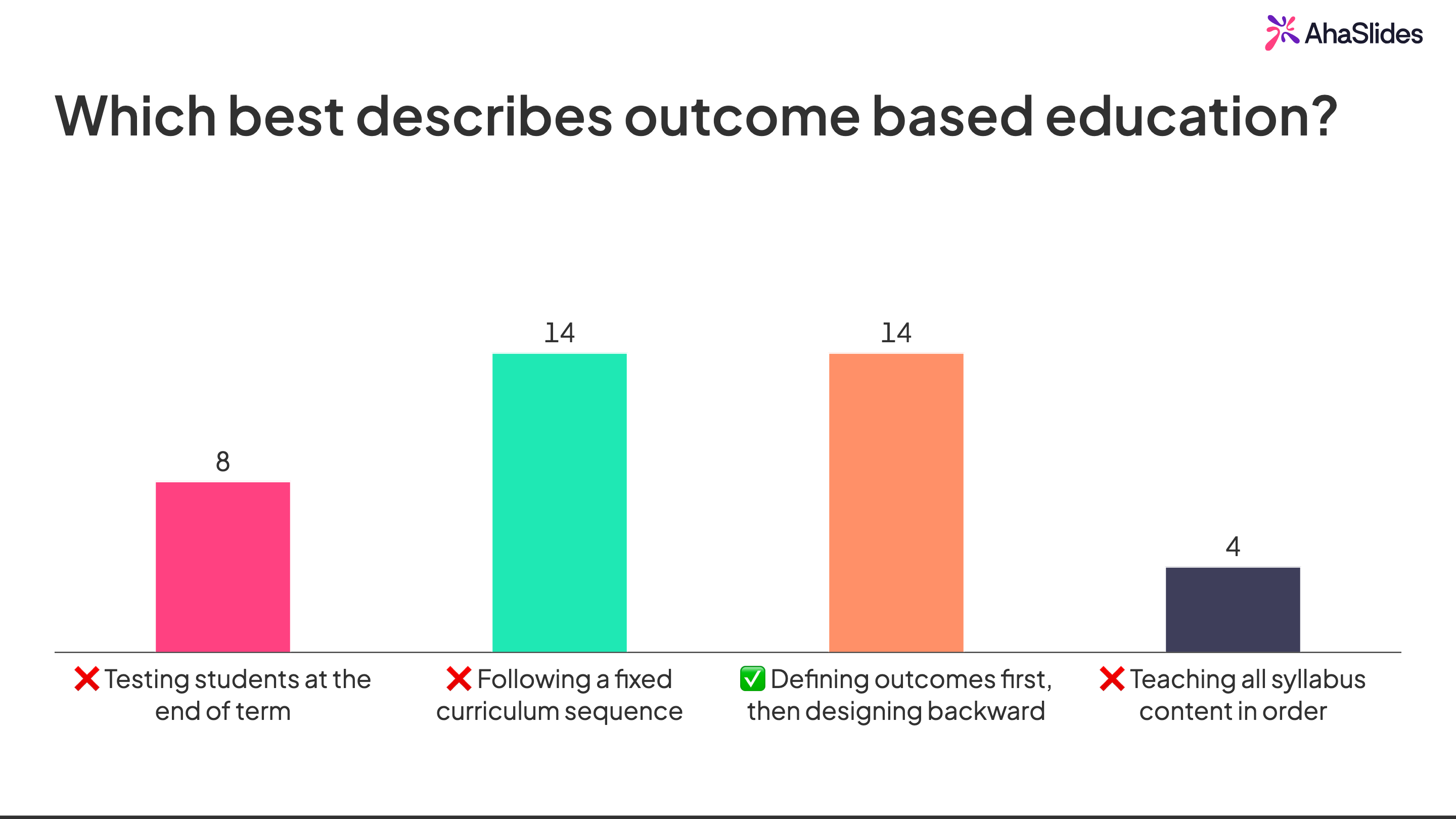
Quiz slides for competency checks. After covering a core concept, run a quick quiz tied directly to the lesson's stated outcome. Live results appear as a bar chart. You can see in seconds whether the class is ready to move on or needs another pass.
Poll slides for confidence checks. A simple "How confident are you about this?" poll before transitioning to the next topic tells you whether students are ready to apply the concept or still uncertain.
Word cloud for activating prior knowledge. At the start of a unit, a word cloud prompt reveals what students already understand and where gaps exist, giving you a baseline to design from.
Open-ended questions for reflective outcomes. If one of your outcomes is "students can apply X to a new situation," an open-ended question mid-lesson shows whether that transfer is happening, not just factual recall.
Q&A for student-driven review. An anonymous Q&A session at the end of a unit surfaces gaps students have not voiced aloud, which is often where real misalignment between instruction and outcomes hides.
For a course whose outcomes span several units or a full term, the AhaSlides Online Course Builder lets you sequence these checks lesson by lesson, so each course outcome has its own live check built in rather than one exam at the end.
OBE in higher education and professional training
In higher education, OBE is now a requirement rather than an option. Accreditation bodies for engineering (ABET, NBA), medicine, nursing, and law require universities to map every course assessment to formally stated learning outcomes. [2]
Outside academia, corporate L&D teams apply the same logic to workplace training. Rather than tracking attendance at a session, OBE-aligned training programs define what employees must be able to do afterward and assess against that standard.
The shift in both contexts is identical: from "did they receive the information?" to "can they now perform the skill?"
Three types of OBE
Spady [1] identifies three broad approaches within the OBE framework, reflecting different levels of transformation:
Traditional OBE applies outcome-based logic to existing structures. Outcomes are defined, but the underlying curriculum sequence and assessment formats remain largely unchanged.
Transitional OBE adjusts both curriculum and assessment to align more directly with outcomes. Teaching methods diversify, and performance-based assessment becomes more prominent.
Transformational OBE redesigns the entire educational experience around outcomes. There is no fixed course structure: learning pathways are fully individualized, and the only constant is the exit outcome all learners must demonstrate.
Most schools and institutions operate in the transitional range, adapting their existing structures rather than rebuilding from the ground up.
Key takeaways
Outcome based education inverts the traditional design sequence. Outcomes are defined first, curriculum is built backward from them, and the measure of success is demonstrated performance rather than content coverage.
The four principles (clarity of focus, designing back, high expectations, expanded opportunities) give educators a concrete framework for building courses that connect directly to what students need to be able to do.
The practical challenge is making that connection visible during instruction, not just at the end. Real-time checks tied to stated outcomes close the gap between teaching and learning, and give you actionable data while there is still time to act on it.
Sources:
[1] Spady, W. (1994). Outcome-Based Education: Critical Issues and Answers. American Association of School Administrators.
[2] ABET. (2024). Criteria for Accrediting Engineering Programs, 2024–2025. Accreditation Board for Engineering and Technology.