



The best survey question samples use rating scales (1–5 or 1–10) for quantifiable attitudinal data, Likert scales (Strongly Agree to Strongly Disagree) for perception and opinion questions, multiple-choice for categorical data, and open-ended questions for qualitative depth. Rating scales work best for satisfaction and NPS measurement because they produce numerical data that can be trended over time; Likert scales for employee engagement, training evaluation, and culture assessments where relative agreement matters; multiple-choice for demographic data and behavioral frequency; and open-ended questions sparingly (1–2 per survey) near the end where completion fatigue is lowest. The most common survey design errors are leading questions ("How much did you enjoy our excellent service?"), double-barreled questions ("Rate the quality and speed of our support"), and scales with unbalanced positive/negative options — all of which corrupt your data before analysis begins.
A survey is only as good as its questions. You can have the right audience, the right timing, and a polished design, but if the questions are vague or leading, the responses won't tell you anything useful.
This post collects 65+ ready-to-use question samples across five practical categories: customer satisfaction, flexible work, employee engagement, training effectiveness, and student experience. Each section includes guidance on what the questions are actually trying to surface.
What makes a survey question work?
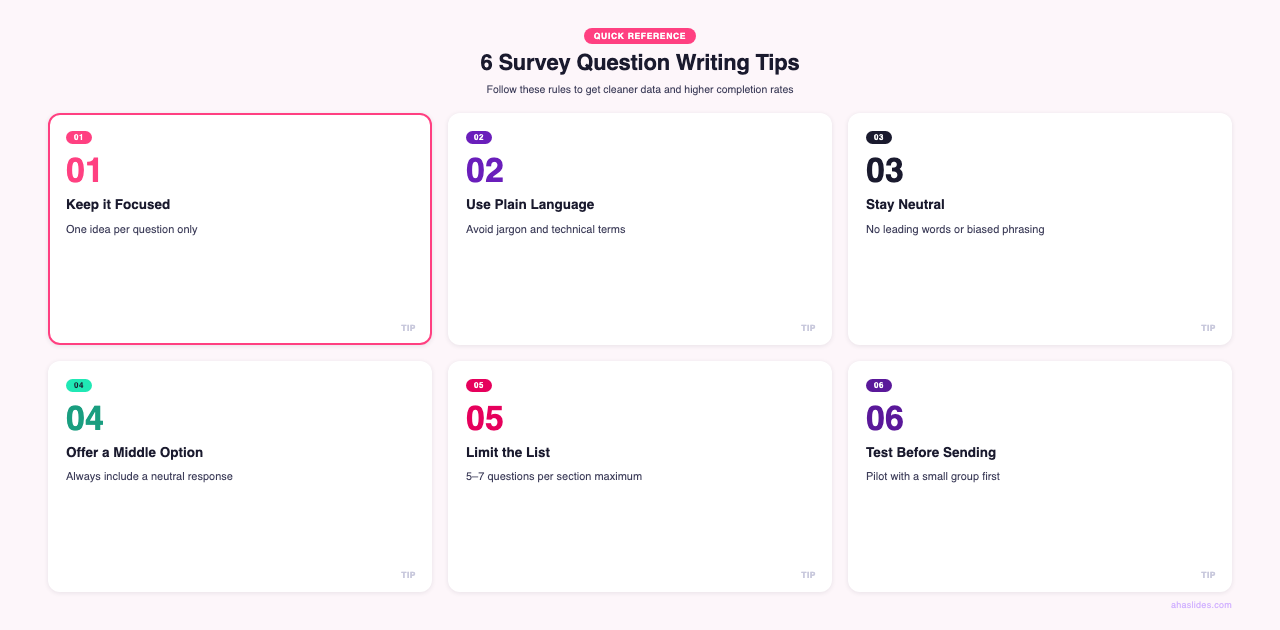
Before the examples: a few principles worth keeping in mind.
Good survey questions do one thing. They ask about one topic, use plain language, and avoid assumptions. "How satisfied were you with the presenter's knowledge and delivery?" is two questions. "Was our service helpful?" assumes the respondent used it. Neither belongs in a survey you intend to act on.
The most common question formats for professional surveys are:
- Rating scales (1–5 or 1–10) for measuring degree
- Agree/disagree statements (Likert-style) for measuring attitudes
- Multiple choice for categorical data
- Open-ended questions for qualitative context
Most surveys work best as a mix: scales and agree/disagree items capture patterns across a group, while one or two open-ended questions at the end capture the specifics you didn't think to ask about.
Customer satisfaction survey questions
Customer satisfaction surveys tell you where the experience breaks down before customers stop returning. These questions cover overall impression, specific touchpoints, and likelihood to recommend.
Overall satisfaction
- Overall, how satisfied are you with our products or services?
- On a scale of 1–5, how would you rate the quality of what you received?
- How would you rate your overall experience with our company?
- On a scale of 1–5, how would you rate our customer service?
- How likely are you to recommend us to a friend or colleague?
Value and ease
- Do you feel you received value for the money you spent with us?
- Was our company easy to do business with?
- Were your needs addressed in a timely manner?
Improvement
- What do you like most about doing business with us?
- How could we improve our products or services to better meet your needs?
- Is there anything that could have been handled better?
- Is there anything else you'd like us to know?
The NPS-style recommendation question (item 5 above) is worth using carefully. Fred Reichheld introduced the concept in a 2003 Harvard Business Review article as a single-question proxy for customer loyalty [1]. It works well as one data point, but shouldn't be the only metric you track.
Flexible work survey questions
Flexible work surveys help HR teams understand what arrangements employees actually want, before rolling out a policy based on assumptions. These questions work well before a pilot or at the end of a trial period.
Preferences and priorities
- How important is flexibility in your working arrangements?
- Which flexible work options appeal most to you? (Part-time hours / flexible start and end times / remote work / compressed work week)
- On average, how many days per week would you prefer to work remotely?
- What benefits do you see in flexible arrangements?
- What concerns, if any, do you have about flexible work?
Productivity and support
- How productive do you think you would be working remotely full-time?
- What technology or equipment would you need to work effectively from home?
- What support from your manager would make flexible work successful for you?
- How might more flexibility improve your work-life balance?
Post-trial evaluation
- Overall, how satisfied were you with the flexible work trial period?
Employee engagement survey questions
Only 21% of employees globally are engaged at work, according to Gallup's 2025 State of the Global Workplace report, a two-point drop from the previous year, and only the second decline in twelve years [2]. The cost of that disengagement: an estimated $438 billion in lost productivity worldwide.
Research from the University of Warwick found that happier employees are 12% more productive in controlled experiments [3]. That makes employee engagement surveys one of the more directly business-relevant things an HR team can run.
These questions are organized by theme so you can select the sections most relevant to your organization.
Job satisfaction
- How satisfied are you with your job overall?
- How satisfied are you with your current workload?
- How satisfied are you with your relationships with colleagues?
Engagement and pride
- I am proud to work for this organization. (Strongly disagree → Strongly agree)
- I would recommend this company as a great place to work.
Management effectiveness
- My manager provides clear expectations for my work.
- My manager motivates me to do my best.
Communication
- I am aware of what is happening in my department.
- Important information reaches me in a timely manner.
Work environment
- I feel my work makes a meaningful contribution.
- My physical working conditions allow me to do my job well.
Benefits and compensation
- The benefits package meets my needs.
- What additional benefits would matter most to you?
Open-ended
- What do you like most about working here?
- What is the one thing we could do to make this a better place to work?
The last question is worth keeping even if you only run one open-ended item. It consistently surfaces issues that rating scale questions miss.
Training effectiveness survey questions
Training evaluations tend to get skipped or rushed. That's a problem, because without feedback data it's impossible to know whether a program is changing behavior or just consuming budget.
Donald Kirkpatrick's four-level model (Reaction, Learning, Behavior, Results) is the most widely referenced framework for training evaluation [4]. Most post-training surveys focus on Level 1 (Reaction), which captures immediate impressions. The questions below cover Levels 1 and 2 and can be extended for longer-term follow-up at Level 3.
Content and relevance
- Was the content covered in the training relevant to your job?
- Will you be able to apply what you learned in your daily work?
- Was the content well-organized and easy to follow?
- Were the training materials and resources helpful?
- What additional topics would have made this training more useful?
Delivery and format
- Was the delivery method (in-person / online / blended) effective for this content?
- Was the pace of the training appropriate?
- Was the trainer knowledgeable and easy to understand?
- Did the trainer effectively involve participants?
Overall assessment
- How useful was the training overall? (1–5)
- Do you feel more confident in your role after this training?
- How do you expect this training to impact your work going forward?
- What was the most useful part of the training?
- What could be improved?
- How would you rate the overall quality of this training?
Example from practice: A retail company running quarterly compliance training added three of these questions to their post-session form and discovered that 60% of participants found the online delivery format harder to follow than in-person sessions. They shifted to a blended format the following quarter and saw completion rates improve.
Student experience survey questions

Student experience surveys help academic departments identify where a program is working and where it isn't, before students disengage or leave. These questions span academic quality, facilities, and wellbeing.
Academic quality
- Is the course content covered at the right difficulty level?
- Do you feel you are learning skills that will be useful after graduation?
- Are instructors engaging and knowledgeable?
- Do instructors provide feedback that helps you improve?
Resources and access
- Are learning materials and resources accessible when you need them?
- How could library or lab resources be improved?
Workload and balance
- Is the course workload manageable?
- Do you feel you have a healthy balance between academic and personal life?
Wellbeing and support
- Do you feel supported when you face personal or mental health challenges?
- How could the institution better promote student wellbeing?
Facilities
- Are classrooms and campus spaces conducive to learning and study?
- What facilities or spaces need the most improvement?
Overall satisfaction
- How satisfied are you with your program so far?
- Would you recommend this program to a prospective student?
- Is there anything else you'd like us to know?
Common mistakes to avoid
Even well-intentioned surveys can produce data that's hard to act on. Here are four patterns that consistently get in the way.
Leading questions. A question like "How much did you enjoy the training?" assumes the respondent enjoyed it at all. Replace it with a neutral version: "How would you rate the training overall?" The goal is to capture what people actually think, not to confirm what you hope is true.
Too many open-ended questions. Open-ended questions earn their place, but ask three in a row and you will watch your completion rate fall off a cliff. Two or three per survey, near the end, is the sweet spot.
Skipping the "why" question entirely. Rating scale questions tell you where the score landed; they don't tell you why. Adding one open-ended question after a low-rated item: "What would have made this better?" gives you the context needed to take action. Without it, you know there's a problem but not what to fix.
Sending surveys too infrequently. A once-a-year employee engagement survey captures a snapshot that may not reflect how people feel most of the time. Shorter, more frequent pulse surveys, even five or six questions sent quarterly, give you trends over time and make it easier to connect changes in engagement to specific events or decisions. The goal isn't more data; it's more timely data.
Choosing what to include
A few practical guidelines before you send:
Keep it short. Surveys longer than 10–12 questions see significant drop-off in completion rates. Pick the questions that will actually change a decision if the answer surprises you.
Match the format to the question. Use rating scales when you need to rank or compare. Use agree/disagree statements when you're measuring attitudes. Use open-ended questions when you need specific examples or explanations, not as a substitute for clear closed questions.
Sequence matters. Start with easier, lower-stakes questions and leave open-ended or sensitive items for the end. People who complete the first few questions are more likely to finish.
Avoid double-barreled questions. "How satisfied are you with the content and delivery?" forces a single answer to two separate things.
Running surveys with AhaSlides
AhaSlides is an all-in-one audience engagement platform with rating scales, open-ended questions, multiple choice polls, word clouds, and live Q&A, covering every format in this post. Run surveys live during a training session so results appear on screen while the session is still fresh, or send them asynchronously for people to complete in their own time.
Sources
[1] Reichheld, F. (December 2003). "The one number you need to grow." Harvard Business Review. https://hbr.org/2003/12/the-one-number-you-need-to-grow
[2] Gallup. State of the Global Workplace: 2025 Report. https://www.gallup.com/workplace/349484/state-of-the-global-workplace.aspx
[3] Oswald, A., Proto, E., & Sgroi, D. (2015). "Happiness and productivity." Journal of Labor Economics, 33(4), 789–822. Summary: https://wrap.warwick.ac.uk/63228/7/WRAP_Oswald_681096.pdf
Frequently asked questions
What are the most effective survey question samples for HR?
The most effective HR survey question samples combine: rating scales for overall satisfaction ("On a scale of 1–10, how satisfied are you with your current role?"), Likert scales for engagement and culture perceptions ("I feel my contributions are valued by my manager"), open-ended questions for qualitative depth ("What would make you more likely to stay in your role?"), and frequency scales for behavior tracking ("How often does your manager give you constructive feedback?"). Mix question types to prevent response pattern bias from setting in.
What survey question types should you avoid?
Avoid leading questions ("How much did you enjoy our excellent service?"), double-barreled questions ("Rate the quality and speed of our support" — two separate questions forced into one), and scales with unbalanced positive/negative options. Also avoid yes/no questions for nuanced topics — they compress complex attitudes into binary data that cannot be segmented, trended, or acted on meaningfully.
How many questions should an employee survey have?
An annual employee engagement survey: 15–30 questions (15–20 minutes). A pulse survey: 3–7 questions (under 5 minutes). A post-training survey: 5–10 questions. Completion rates drop sharply past 5 minutes for pulse surveys and past 20 minutes for annual surveys — respect the time commitment you are asking for.
What order should survey questions follow?
Start with easy, non-sensitive questions to build response momentum. Place demographic questions at the end — not the beginning — because they can feel intrusive and deter completion before respondents reach your core questions. Put open-ended questions near the end where completion fatigue is highest, since they require the most effort and will be skipped if placed early.
[4] Kirkpatrick, D. L. (1959). "Techniques for evaluating training programs." Journal of the American Society of Training Directors, 13(3), 21–26. Overview: https://www.kirkpatrickpartners.com/the-kirkpatrick-model/