


Think Pair Share is one of the most researched collaborative learning strategies in education, and also one of the most inconsistently used. Most teachers have tried it. Far fewer have made it genuinely work across their whole class, reliably, at the right pace, for their subject.
This guide gives you everything you need to do exactly that: a grade-by-grade breakdown, five fully structured activities with real prompts, subject-specific examples, a troubleshooting section for when things go sideways, and a clear approach to assessment. By the end, you'll have enough to run Think Pair Share with confidence on Monday morning.
What is Think Pair Share?
Think Pair Share (TPS) is a collaborative learning strategy developed by Frank Lyman in 1982. Students respond to a question or prompt in three stages
- Think: each student reflects independently and forms their own initial response
- Pair: students discuss their thinking with a partner
- Share: pairs report back to the whole class, either voluntarily or by selection
The logic is simple but powerful. By giving students structured think time before discussion, TPS dramatically increases participation quality. students arrive at the group share with something to say, rather than waiting for someone else to start. Research consistently shows it improves comprehension, confidence, and the quality of classroom discourse (Marzano & Pickering, 2005).
How Long Should Each Phase Be?
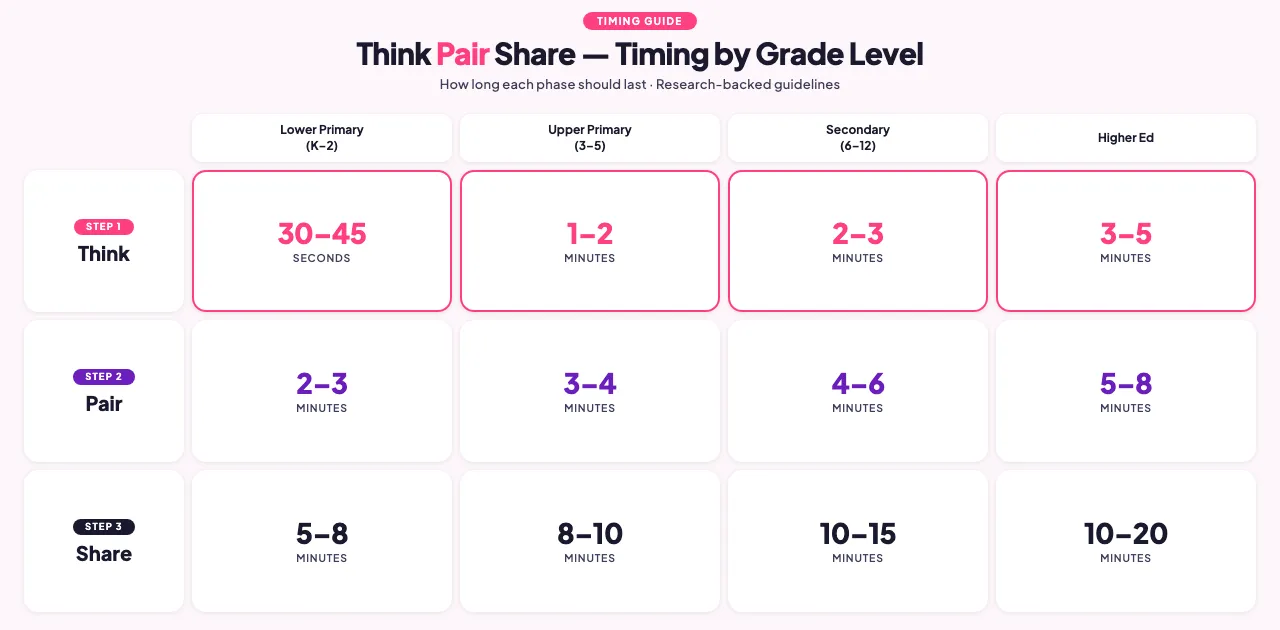
This is one of the most common questions from teachers implementing TPS for the first time, and the research has a clear answer: err on the side of shorter rather than longer, especially for think time.
A common mistake is giving too much think time, which leads to students either finishing quickly and losing focus, or second-guessing themselves into silence. Tight think time — enough to jot down one or two ideas — keeps the energy up when pairs begin.
Think Pair Share Across Grade Levels
TPS is not one-size-fits-all. The pairing method, question type, and share format all need to suit your students' developmental stage.
Lower Primary (K–2)
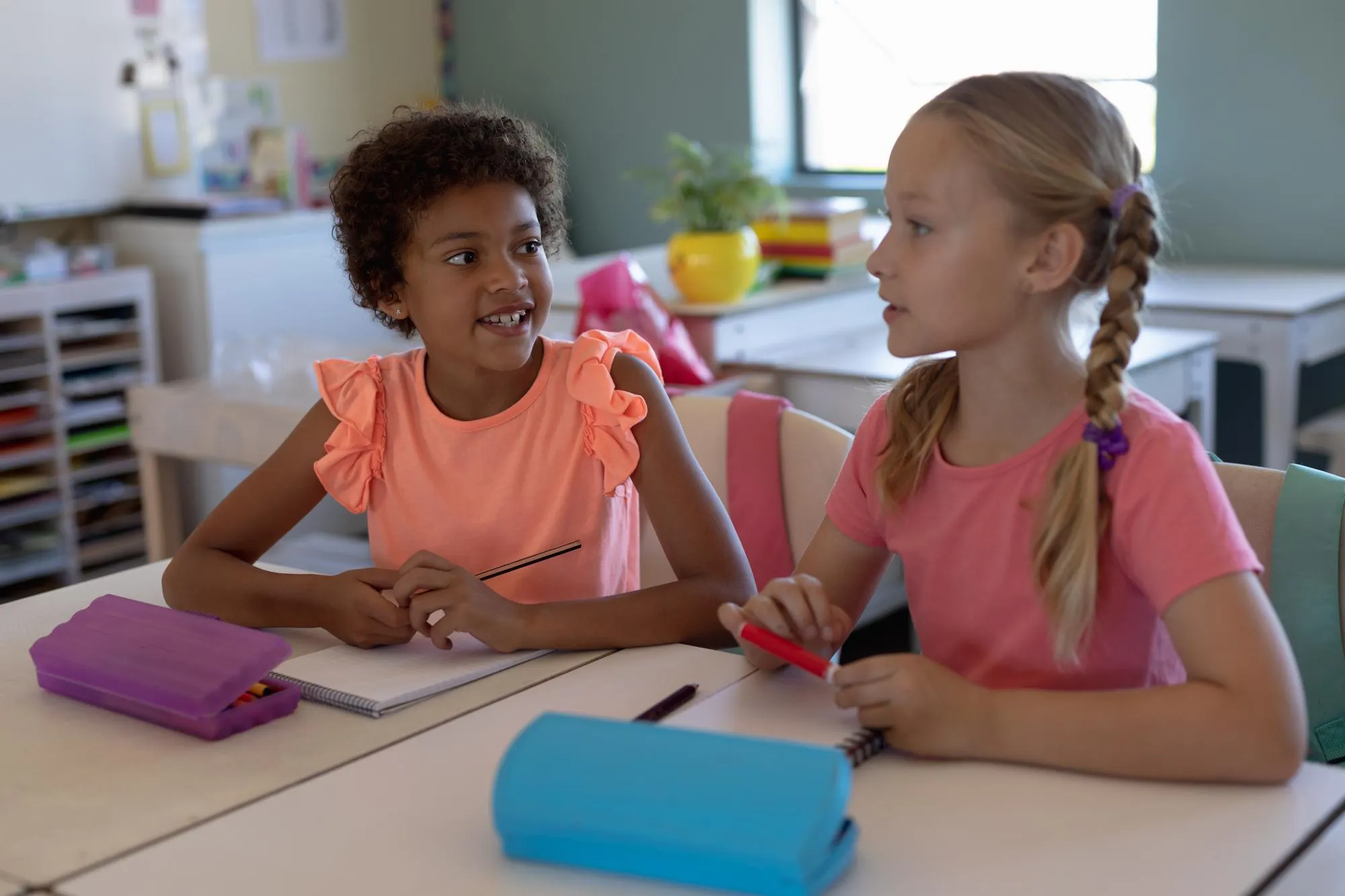
At this age, think time is less about writing and more about forming a mental image or a single idea. Prompts should be concrete and short. Pairing should be pre-assigned (random pairing adds cognitive load that younger children don't need).
What it looks like: The teacher shows a picture of a frog and asks, "What do you notice about this animal?" Students look for 30 seconds, then turn to their pre-assigned partner and share one thing they noticed. Pairs report back and the teacher records responses on the whiteboard as a class list.
Tips for this age group:
- Use "turn and talk" rather than writing during the Think phase
- Assign shoulder partners in advance — permanent pairs reduce transition time
- Use a physical cue (a bell, clapping pattern) to signal phase transitions
- Keep the Share phase to 3–5 pairs maximum, or you lose the room
Upper Primary (3–5)
Students at this level can handle written think time, more complex prompts, and brief disagreement during the pair phase. This is a great age to introduce the idea that partners might have different answers — and that's the point.
What it looks like: Before a lesson on fractions, the teacher asks: "Is ½ always bigger than ¼? Write down your answer and why you think so." After 90 seconds of individual writing, partners compare their reasoning. Pairs then share the most interesting disagreement they had.
Tips for this age group:
- Give students a sentence starter during think time: "I think… because…"
- Ask pairs to share their disagreement, not just their answer — this surfaces misconceptions faster
- Begin varying how pairs are formed: sometimes shoulder partners, sometimes a random pair, sometimes mixed ability
Secondary (6–12)
At secondary level, TPS can carry real intellectual weight. Prompts can be genuinely open-ended, controversial, or analytical. The pair phase can include peer challenge — students should be expected to push back on each other, not just agree.
What it looks like: In a Year 10 history class: "Was dropping the atomic bomb on Hiroshima justified? Write your initial position and your strongest reason." Students write for 2–3 minutes, then spend 5 minutes with a partner comparing positions and trying to find one point of agreement and one genuine point of disagreement. Pairs then report both — their point of agreement AND their unresolved disagreement — to the class.
Tips for this age group:
- Give students a structured framework for the pair phase: "First, each person shares their view without interruption. Then, ask one clarifying question. Then, find one thing you agree on."
- Name the share format clearly: are you asking pairs to share their consensus, their disagreement, or the most surprising thing their partner said?
- At this level, cold-calling pairs (rather than waiting for volunteers) is highly effective — and students expect it if you set the norm early
Higher Education
In university settings, TPS can be used in lectures of any size. It breaks passive listening, surfaces confusion, and gives students a low-stakes way to test their understanding before committing to an answer publicly.
What it looks like: Mid-lecture on supply and demand: "A government introduces a price ceiling on rent below the market equilibrium. In 2–3 sentences, explain what you predict will happen to the quantity of rental housing supplied. Then convince your neighbour." After 4 minutes, the lecturer cold-calls 3–4 pairs and asks each one: "Where did you agree? Where did you end up disagreeing?"
Tips for this setting:
- For large lectures, use AhaSlides polls to collect individual responses before the pair phase — this gives the lecturer a real-time picture of where the cohort is before discussion
- Assign pairs for the semester in tutorial groups so the social dynamic is already established
- In online lectures, breakout rooms of 2 work well — set a strict 5-minute timer and give pairs a single written output to paste into the chat when they return
Subject-Specific Think Pair Share Examples
Mathematics
TPS is particularly powerful in maths because it externalises reasoning — students have to explain their process, not just state an answer, which exposes gaps in understanding that a correct answer alone would hide.
Sample prompt (Primary): "I multiplied 4 × 7 and got 28. My partner got 21. Without looking at a calculator, how can we figure out who is right?"
Sample prompt (Secondary): "Here are two different methods for solving this quadratic. Work out the answer using method A. Your partner uses method B. Compare your answers and your working. If they differ, find the step where you diverged."
Teacher role during pair time: Circulate and listen specifically for incorrect reasoning that sounds plausible. These are gold for the share phase — ask that pair to share their reasoning first.
English Language Arts / Literacy
TPS works brilliantly as a pre-writing tool, a comprehension check during reading, and a way to surface multiple interpretations of a text.
Sample prompt (Upper Primary, during reading): "Why do you think the main character lied to her friend? Write down one reason. Now find out if your partner agrees — and whether they think the character was right to do it."
Sample prompt (Secondary, analytical): "What is the author's attitude towards wealth in this passage? Find one quotation that supports your view. Share it with your partner and see if they chose the same evidence or different evidence."
Teacher role during pair time: Listen for students who have strong evidence but weak analytical language — prompt them with: "Can you say what the author implies rather than says?"
Science
Science is ideal for TPS because predictions and hypotheses naturally produce disagreement — and disagreement is exactly what drives discussion.
Sample prompt (Primary): "Before we do the experiment: what do you think will happen when we put the raisin in the fizzy water? Write your prediction. Now check: does your partner agree?"
Sample prompt (Secondary): "A plant is placed in a dark room for 48 hours. Predict what will happen to its starch levels and explain the biological process behind your prediction. Compare your explanation with your partner's — do you agree on the outcome but for different reasons?"
Teacher role during pair time: Prompt students to distinguish between what they predict and why — many students will have the right outcome for a fuzzy reason. The pair phase is where that gets sharpened.
Social Studies / Humanities
These subjects are natural homes for TPS because there are rarely single correct answers, and students benefit from encountering a perspective different from their own before committing to a position.
Sample prompt (Secondary): "Should countries be legally required to accept climate refugees? Write your position and your best argument for it. Then — and this is the challenge — try to steelman your partner's opposing view. What is the strongest version of the position you disagree with?"
Teacher role during pair time: Intervene if students are just agreeing with each other without engaging the harder question. Prompt: "You both agree — what would someone who disagrees say, and how would you answer them?"
5 Fully Structured Think Pair Share Activities
Activity 1: Gallery Walk + TPS
Best for: Upper Primary, Secondary | Any subject
What it is: Students examine a set of posters, diagrams, or quotations displayed around the room, then use TPS to discuss what they've seen.
How to run it:
Sample prompt: (History) "Looking at the four propaganda posters from WWI on the walls: which one do you think was most effective, and why? Write your answer before talking to anyone."
Teacher role during pair time: Listen for pairs whose "shared question" is actually a factual gap (something you haven't taught yet) vs. a genuine analytical question. Flag the latter for whole-class discussion.
Assessment opportunity: Collect the response sheets. The individual annotations are a clean formative data point showing each student's starting comprehension before discussion shaped their thinking.
Activity 2: Rapid Fire Rounds
Best for: All ages | Review and retrieval practice
What it is: A structured series of quick TPS exchanges used to consolidate or review content, with pairs rotating after each round.
How to run it:
Sample questions (Science revision):
- "Name the three parts of the cell responsible for energy production."
- "What is the difference between mitosis and meiosis?"
- "A student says that photosynthesis happens only during the day. Is that accurate? Why or why not?"
Why the rotation matters: Each new partner brings a slightly different knowledge base. Students who were confused in round one often get clarity from a new partner in round two — this is peer instruction working exactly as it should.
AhaSlides tip: Post each question on an AhaSlides slide with a 45-second timer visible on screen. This keeps the pace tight without you having to watch a clock.
Activity 3: Think Pair Share Draw

Best for: Primary, Lower Secondary | Science, Maths, Geography, any concept with spatial or visual structure
What it is: After the pair discussion, students produce a shared visual — a diagram, sketch, or concept map — that represents their combined understanding.
How to run it:
Sample prompt (Primary Science): "Draw the water cycle as you understand it after reading page 12. Label as many parts as you can. Then — with your partner — combine your two diagrams into one that includes everything you both drew."
Why it works: The act of creating a shared visual forces students to negotiate meaning. "I drew an arrow going that way" requires them to explain their understanding of the process, not just recall a label.
Assessment opportunity: Photograph the paired diagrams. They reveal misconceptions far more clearly than written answers — look especially for what students leave out, not just what they get wrong.
Activity 4: Think Pair Share Debate
Best for: Secondary, Higher Ed | Humanities, Ethics, Science policy, Literature
What it is: A structured TPS where pairs are assigned opposing positions, forcing both students to develop arguments for a view — even one they personally disagree with.
How to run it:
Sample debate prompt (Secondary): "Position A: Social media companies should be held legally responsible for content that causes harm to users under 18. Position B: Legal responsibility would destroy free expression and is unworkable in practice."
Key rule to enforce: During the pair phase, students cannot simply agree. Their job is to find the strongest version of the opposing argument, not to defeat it cheaply.
AhaSlides tip: Run a live poll before the Think phase asking students their initial position. Run the same poll after the Share phase.
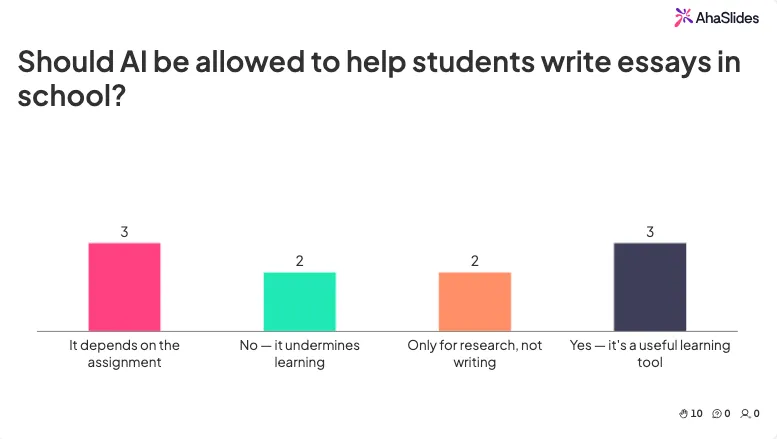
Showing the before/after shift (or lack of it) is a powerful discussion prompt in itself.
Activity 5: Dictionary Hunt (Vocabulary TPS)
Best for: All ages | Any subject with technical vocabulary
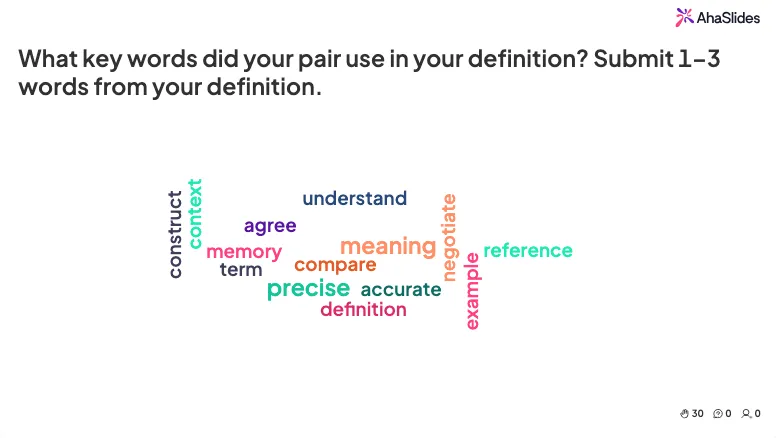
What it is: Students independently work out or look up the meaning of a term, then compare definitions with a partner and construct a single, precise definition together.
How to run it:
What makes this work: Vocabulary is most durably learned when students wrestle with meaning rather than copy it. The negotiation in the pair phase — "your definition says X but mine says Y, can both be right?" — is exactly the kind of semantic wrestling that builds retention.
Extension: Use AhaSlides' word cloud to collect all the words pairs used in their definitions.
The most common words signal what students have grasped; conspicuously absent words signal gaps.
Think Pair Share in Virtual and Hybrid Classrooms

Fully virtual (synchronous):
- Use breakout rooms of exactly 2 — set the timer to match your intended pair phase length
- Give pairs a single deliverable to paste into the chat when they return (one sentence summarising their agreement, or one unresolved question)
- Use AhaSlides for the Think phase — students submit their individual response to a poll or open question before breakout rooms open, giving you a record of pre-discussion thinking
- Cold-call by bringing specific pairs back into the main room to share
Hybrid (some students in-room, some remote):
- Pair remote students with each other via breakout rooms, not with in-room students — mixed-mode pairs almost always disadvantage the remote student
- Give remote pairs the same time as in-room pairs, but bring them back first to share — this prevents them from feeling like an afterthought
- Use a shared digital whiteboard (or AhaSlides' open-ended slide) so remote pairs can show their work during the Share phase on the same screen as the in-room discussion
Asynchronous TPS:TPS can even work asynchronously. Post a question on a discussion board. Students write their Think response as a reply. They are then assigned a partner to respond to (the Pair phase). A final summary post is their Share. This works well for university courses with significant asynchronous components.
How to Assess Think Pair Share
TPS generates multiple assessment opportunities — but only if you plan for them deliberately.
Formative data from the Think phase: Collect individual written responses before pair discussion begins. These show you where each student started, uninfluenced by their partner. This is useful diagnostic data for identifying students who are confused or have a misconception that discussion might paper over rather than correct.
Observation during the pair phase: Circulate with a simple tracking sheet — a class list with two columns: "engaging with prompt" and "needs follow-up." You don't need to assess deeply here; you're identifying who to call on and who to check in with after class.
Quality of the share phase: Rather than evaluating whether an answer is "right," listen for reasoning quality. Do pairs explain why they came to their conclusion? Can they articulate where they disagreed and how they resolved it? These are indicators of genuine understanding, not just convergence on the right answer.
Exit tasks: A brief post-TPS exit slip ("Write one thing you understood better after talking to your partner, and one thing you're still unsure about") gives you clean formative data and signals to students that the learning in the pair phase actually matters.
Summative integration: TPS is a formative tool, but the thinking it generates feeds directly into summative tasks. An analytical essay written after a series of TPS discussions will almost always be stronger than one written without peer discussion — the students have already rehearsed their reasoning aloud. You can make this connection explicit: "The discussion you just had is the outline for your paragraph tonight."
5 Tips for More Engaging Think Pair Share Sessions
1. Write better prompts. The quality of a TPS session rises and falls with the question. Avoid closed questions with single correct answers — these kill pair discussion. Instead, use:
- "What do you think and why?"
- "Do you agree with [statement]? What's your strongest argument?"
- "Two students gave different answers to this problem. Who is right, and how do you know?"
- "What would happen if… ? Make a prediction and explain your reasoning."
2. Use think time consistently — even when it feels awkward. Silence during the Think phase feels uncomfortable, especially early in the year. Resist the urge to fill it. Students who are told to write before they talk produce better pair discussions, and students who know think time will always happen stop trying to start talking early.
3. Vary your pairing strategy deliberately. Shoulder partners (consistent same-seat pairs) are easiest to manage and good for lower-stakes tasks. Mixed-ability pairs are more valuable when one student's knowledge can scaffold another's. Same-ability pairs work well for challenge tasks where both students need to work at the edge of their understanding. Random pairing adds novelty but should be reserved for short, lower-stakes TPS activities.
4. Make the Share phase purposeful, not performative. "Pair 6, what did you discuss?" generates a generic answer. "Pair 6, what was the thing your partner said that most surprised you?" generates insight. Frame share questions to surface thinking, not just summarise it.
5. Use technology to extend, not replace, the structure. AhaSlides lets you collect individual Think responses at scale (useful in large classes where circulating during think time isn't possible), run live polls to compare pre- and post-discussion positions, display shared questions from pairs during the Share phase, and set visible countdown timers for each phase. The tool works best when it supports the structure — not when it is the structure.
Frequently Asked Questions
What is the Think Pair Share strategy?
Think Pair Share is a structured collaborative learning technique developed by Frank Lyman in 1982. Students respond to a prompt individually (Think), discuss their response with a partner (Pair), then share their combined thinking with the class (Share). It increases participation quality by giving students processing time before they are asked to contribute publicly.
How long should each phase of Think Pair Share last?
Think time is typically 30 seconds to 5 minutes depending on the age group and complexity of the task — shorter for younger students and simpler questions, longer for secondary and higher education with analytical prompts. Pair time is usually 2–8 minutes. Share time varies based on class size and the richness of discussion you want. See the timing table earlier in this guide for grade-specific recommendations.
What makes a good Think Pair Share question?
A good TPS prompt is open-ended, requires reasoning (not just recall), and has enough complexity that two people could genuinely come to different conclusions. "What is the capital of France?" is a bad TPS prompt. "Why do you think France moved its capital to Paris rather than a more central city?" is a much better one. The best prompts have a right answer or a defensible position, but multiple paths to get there.
How do you use Think Pair Share in a large class or lecture?
In large classes, use a polling tool like AhaSlides to collect individual Think responses from every student before the pair phase — this gives you formative data at scale. Pair students with a neighbor. During the Share phase, cold-call 3–5 pairs and ask them to share their disagreement rather than their consensus — this generates richer whole-class discussion without needing to hear from everyone.
How is Think Pair Share assessed?
TPS generates several assessment opportunities. Collecting individual Think-phase written responses gives you pre-discussion diagnostic data. Observation notes during the pair phase help identify students who are struggling. Post-TPS exit slips capture what each student understood and what remains unclear. Over time, TPS directly improves the quality of summative written work because students have rehearsed their reasoning aloud with a peer.
Can Think Pair Share be used online?
Yes. In synchronous online settings, use breakout rooms of exactly two with a defined timer and a specific deliverable (e.g., one sentence to paste into the chat). Use a polling tool for the Think phase to capture individual responses before breakout rooms open. In asynchronous settings, TPS can be adapted to a three-stage discussion board structure: individual post, peer response, summary reply.
References: Lyman, F. (1982). The responsive classroom discussion. In A. S. Anderson (Ed.), Mainstreaming Digest. University of Maryland. | Marzano, R. J., & Pickering, D. J. (2005). Building Academic Vocabulary. ASCD.