

如何打造引人入勝的行銷簡報

部落格縮圖

Marketing presentations come in many forms: pitching a campaign to stakeholders, presenting market research to leadership, selling a product or service to prospects, or training a team on a new strategy. Despite different contexts, effective marketing presentations share common DNA. They diagnose problems, propose solutions, back claims with evidence, and inspire action.

Most marketing presentations fail not because of bad ideas but because of poor execution. Cluttered slides, unfocused narratives, weak visual hierarchy, and insufficient audience engagement dilute even strong marketing strategies. This guide walks you through building presentations that actually move your audience.

The seven essential elements

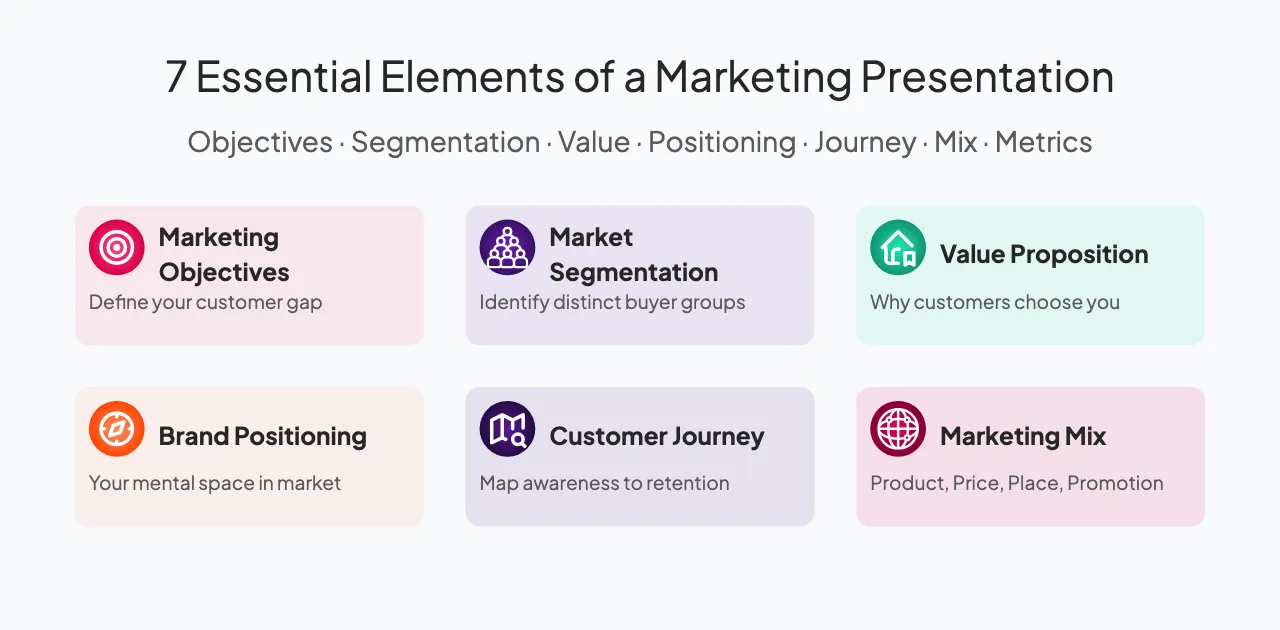
Before designing slides or writing copy, you need a framework. Every effective marketing presentation should contain these seven components:

1. Marketing objectives

What problem are you solving? Start by identifying the gap between where your market is today and where they want to be. A fitness brand isn't selling gym memberships. It's selling confidence, health, and the ability to climb stairs without breathing hard. A project management tool isn't selling software. It's selling fewer meetings, clearer communication, and projects that actually ship on time.

Your marketing objectives articulate these gaps. They answer: What is our audience struggling with? What would success look like for them? Why should they care about solving this now? Write this section for internal alignment, even if your presentation never speaks this explicitly.

Example for a meal-prep delivery service: "Our target customers struggle with decision fatigue around meals and lack time to plan healthy eating. They want nutritious options without the grocery shopping, chopping, and cooking. Our service eliminates those barriers, freeing time for higher-value activities."

2. Market segmentation

You don't market to "everyone." You market to specific segments with distinct needs, preferences, and buying behaviors. Identify your primary segments and understand their unique characteristics. What demographic profiles matter? What cultural or geographic factors influence purchasing? What psychographics define them?

Include segment size (how many potential customers exist in each segment) and growth potential. This justifies why you're pursuing these segments rather than others. It also shapes all subsequent marketing decisions.

示例: "Busy professionals aged 30-50 with household income above $75K represent 60% of our addressable market. They prioritize health but lack time. Secondary segment is college students seeking affordable nutrition. Tertiary segment is fitness enthusiasts wanting optimized macros."

3. 價值主張

Why should customers choose you over competitors? Your value proposition isn't what you offer. It's what you deliver that others don't. If three competitors offer similar products at similar prices, what tips the scale to you?

Articulate your unique value clearly. Is it superior quality? Better customer service? Lower price? Faster delivery? Specific features competitors lack? A cause customers believe in? The strongest value propositions tie to what actually matters to your target segments. Understand what your segments prioritize and align your proposition accordingly.

示例: "Unlike generic meal-prep services, we customize macronutrient ratios based on individual fitness goals. Unlike DIY cooking, we eliminate time investment. Unlike restaurant dining, we reduce cost and calorie uncertainty. We're the fastest path to consistent nutrition."

4、品牌定位

How do you want your target segments to perceive your brand? What mental space do you occupy in their minds? Positioning is distinct from your value proposition. You might position as "premium" while emphasizing quality craftsmanship. Or "democratic" while emphasizing accessibility. Or "innovative" while emphasizing cutting-edge technology.

Positioning shapes messaging, visual design, pricing, and all customer touchpoints. It's the emotional lens through which customers view your functional benefits. Nike's functional value is athletic shoes. Their positioning is aspiration and possibility.

示例: "We position as the 'health hacker's choice' for people who apply optimization principles to fitness. We appeal to data-driven, achievement-oriented professionals who see healthy eating as a system to master, not a chore to minimize."

5. 客戶旅程

Map how customers discover, evaluate, and purchase from you. Where do they start? What touchpoints do they encounter? What questions emerge at each stage? What barriers prevent conversion? What triggers commitment?

The customer journey typically flows from awareness (they discover you exist) through consideration (they evaluate options) to decision (they choose you) to retention (they stay loyal). Each stage has different objectives and messaging.

示例: Awareness stage: Instagram ads targeting fitness influencers. Consideration: Free trial meal plan. Decision: Testimonials from similar customers. Retention: Weekly nutrition tips and loyalty rewards.

6. Marketing mix

How will you execute your strategy? The classic framework includes four Ps: Product, Price, Place, and Promotion. What's your product strategy? Will you offer multiple product lines or stay focused? Will you differentiate on ingredients, customization, or sustainability? Will you add services like nutrition coaching?

Pricing strategy determines positioning and profitability. Premium pricing positions you as high-quality. Competitive pricing positions you as accessible. Loss-leader pricing (initially low) builds adoption. How do you distribute? Online only? Retail partnerships? Food delivery platforms? Direct-to-consumer?

Promotion covers advertising, content, partnerships, influencer work, and direct sales. Which channels reach your target segments? Which deliver best ROI? How will you build brand awareness versus driving immediate sales?

示例: Premium meal-prep delivered to homes within three-mile radius. Price point $12-15 per meal targets value-conscious health enthusiasts, not budget shoppers. Marketing emphasizes Instagram-worthy food, partnerships with fitness professionals, and targeted digital ads to health and wellness searchers.

7. 指標和測量

How will you know if your strategy works? Define success metrics before launch. Track customer acquisition cost (how much you spend to get one customer). Monitor customer lifetime value (total revenue from a customer over their relationship with you). Measure retention rate (what percentage stay month-over-month). Track ROI on marketing spend by channel.

These metrics inform optimization. If acquisition cost is too high, you adjust channels or messaging. If retention is too low, you investigate why customers leave. Data drives decisions, not assumptions.

示例: "Target customer acquisition cost of $45. Target customer lifetime value of $1,200 (representing 27-month average relationship). Track month-over-month retention (target 90%). Measure Instagram ROI separately from Google search ROI."

Team collaborating on documents in a meeting

Seven tips for presentation excellence

Having strategic elements is necessary but not sufficient. You also need to present them compellingly.

Hook your audience immediately

You have 60 seconds to establish why your audience should care. Open with a compelling question, surprising statistic, or relatable scenario. A bad opening: "Today I'm presenting our Q3 marketing strategy." A good opening: "The average person spends 23 hours monthly deciding what to eat. We're eliminating that decision."

Lead with audience needs

Stop presenting what you want to say. Start presenting what they need to hear. A company meeting? Stakeholders care about ROI and risk. An investor pitch? Investors care about market size and growth potential. A sales presentation to prospects? Prospects care about solving their specific problems. Frame your presentation around their priorities, not yours.

Use data-driven design

Avoid slides so dense they require explanation. Limit text to 6 words per slide. Use images, charts, and minimal text. Let data visualizations replace paragraphs. A chart showing customer acquisition cost declining 35% over six months communicates instantly. That same information in paragraph form gets lost.

Include real-world examples

Abstract statements feel hollow. Specific examples feel real. Instead of claiming "customers love our service," feature a customer story: "Sarah, a busy marketing director, tried five meal-prep services before finding us. Within two weeks, she reclaimed five hours monthly. She's now referred twelve colleagues." The specificity creates credibility.

Build shareable moments

Include insights or quotes that stick with people. Things they'll remember, discuss, and share with colleagues. "The average person spends 23 hours monthly deciding what to eat" is more memorable than "customers waste time on meal decisions." Memorable moments increase the half-life of your presentation beyond the room.

Maintain visual consistency

Use your brand colors, fonts, and visual style throughout. Consistent design signals professionalism and reinforces brand identity. Tools like AhaSlides make this simple: select a brand-compliant template and all subsequent slides inherit the design system. You get consistency without design work.

Invite engagement through questions

Don't monologue. Ask questions. Pause for responses. Use interactive elements like polls to gauge audience opinion. When you ask "How many of you have experienced this challenge?" and 70% raise hands, you create shared recognition. The audience moves from passive consumption to active participation.

Structuring your presentation

A solid structure helps audiences follow your logic. Consider this framework:

開場(2分鐘): Hook with a question or statistic. Introduce yourself and your topic. Outline what you'll cover.

Problem (3 minutes): Define the customer problem. Use data and examples. Help your audience feel the problem, not just understand it intellectually.

Solution (5-7 minutes): Present your marketing strategy. Walk through each element: positioning, target segments, value proposition, customer journey, marketing mix. Show how they work together.

Evidence (3 minutes): Provide proof. Share case studies, customer testimonials, or pilot results. Show this approach works.

Financials (2 minutes): Share budget requirements, expected ROI, or financial projections. Numbers that matter to your audience.

Call to action (1 minute): What decision or action do you want? Approval? Feedback? Commitment? Be explicit. Don't leave it vague.

Questions (remaining time): Open the floor. Listen more than you talk. Respond to concerns directly.

Building your first marketing presentation

Start by outlining your seven strategic elements. Document each one clearly. This is your foundation. Next, design slides that communicate each element visually rather than textually. A slide on market segmentation might show your three segments with size, growth, and key characteristics using icons or charts rather than bullet points.

Practice your delivery. Time yourself. Aim to finish 10% under your time limit. This gives space for questions and shows you respect your audience's schedule. Record yourself and watch back. Does your opening hook? Do you seem confident? Do your visuals reinforce or distract from your message?

Share your draft with trusted colleagues. What lands? What confuses? What feels weak? Iterate based on feedback. Your first version won't be your best version. Plan for revision.

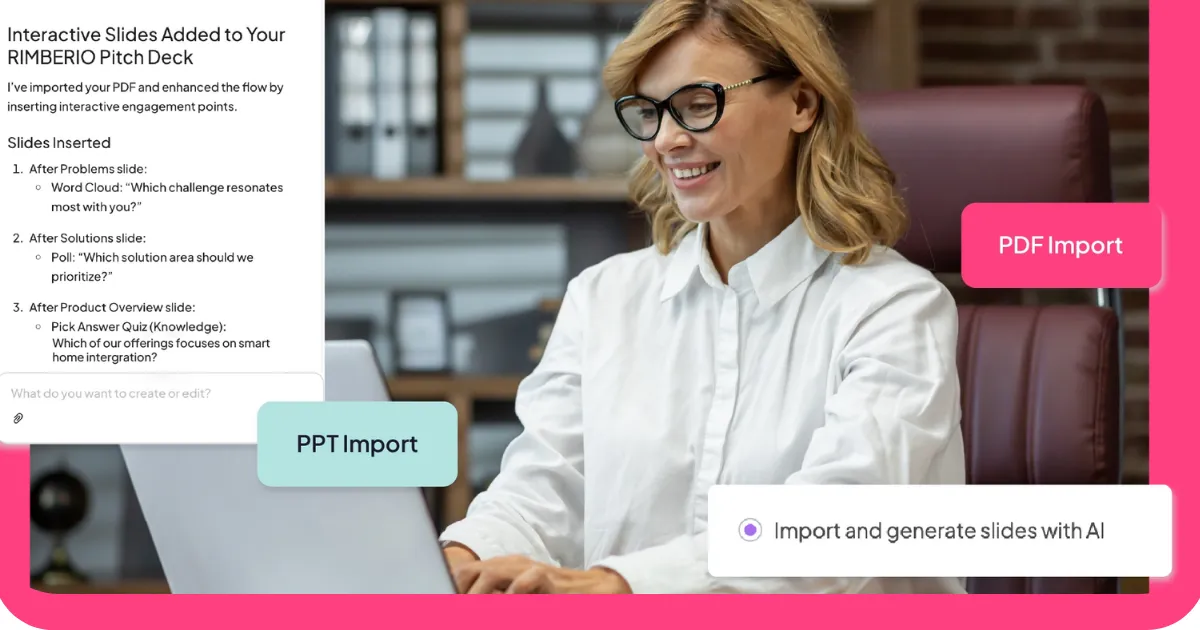
When building, use presentation software designed for clarity. AhaSlides templates accelerate design while maintaining professional quality. Spend your energy on strategy and messaging, not design mechanics.

A strong marketing presentation doesn't oversell. It diagnoses a real problem, proposes a thoughtful solution, backs claims with evidence, and invites action. It respects your audience's intelligence and time. Build that, and you've built something that moves people.

訂閱即可獲得提升觀眾參與度的技巧、見解和策略。
謝謝! 您的提交已收到!
糟糕! 提交表格時出了點問題。

查看其他帖子

AhaSlides 已被福布斯美國 500 大企業所採用。立即體驗互動的力量。

了解更多
© 2026 AhaSlides 私人有限公司