

TED Talks have become shorthand for excellent public speaking. What makes them work so well? The format, the 結構, and the carefully crafted delivery create a template worth copying.
TED's speaker training emphasizes storytelling over pure information delivery. The speakers we remember aren't the ones who overwhelmed us with data; they're the ones who made ideas stick through narrative.
TED Talk structure: The 18-minute advantage
TED's 18-minute time limit isn't arbitrary. It's the window where audiences can maintain deep focus and speakers can develop a coherent idea fully. Longer talks lose audience attention. Shorter talks don't give complex ideas room to breathe.
This constraint shaped the TED Talk formula. Every minute counts. Nothing extraneous survives.
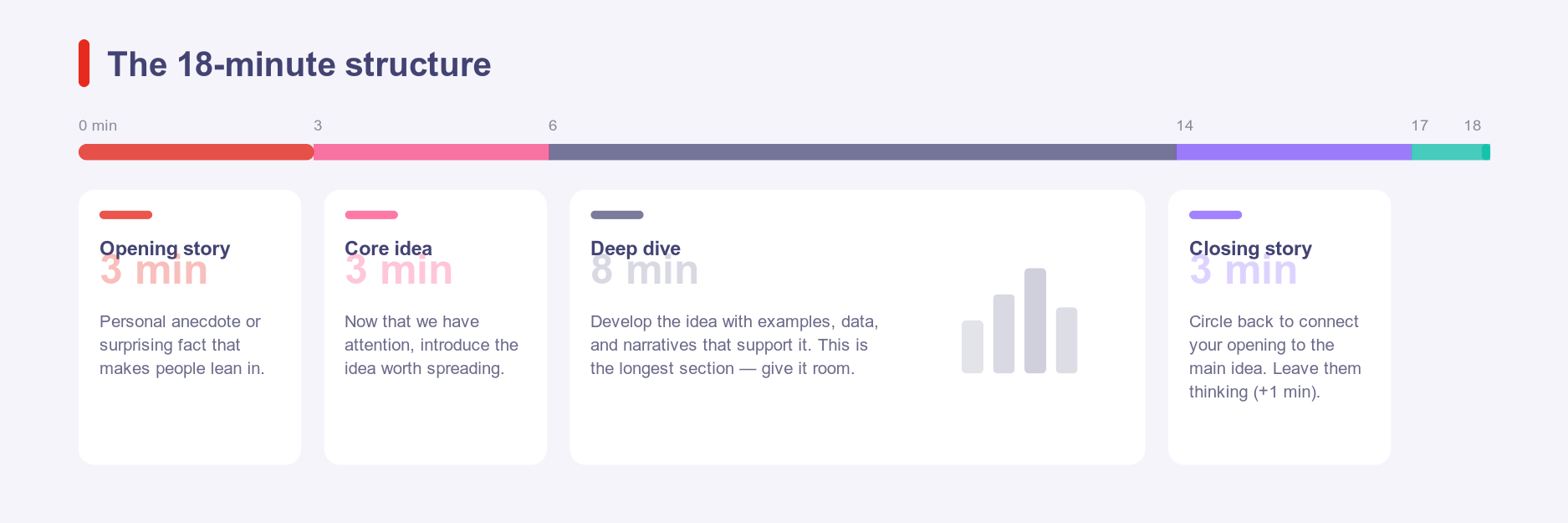
If you have 18 minutes, here's a working 結構體:
- Opening story (3 minutes): Start with a personal anecdote or surprising fact that makes people lean in
- Main idea introduction (3 minutes): Now that we have attention, what's the core idea worth spreading?
- Deep dive (8 minutes): Develop the idea. Show examples, data, or further narratives that support it
- Closing story or insight (3 minutes): Circle back to connect your opening to your main idea
- Call to reflection (1 minute): Leave your audience thinking
This isn't a rigid formula. The proportions shift based on your content. But notice the pattern: you're not trying to cover everything. You're developing one idea thoroughly.
Four TED Talk presentation techniques
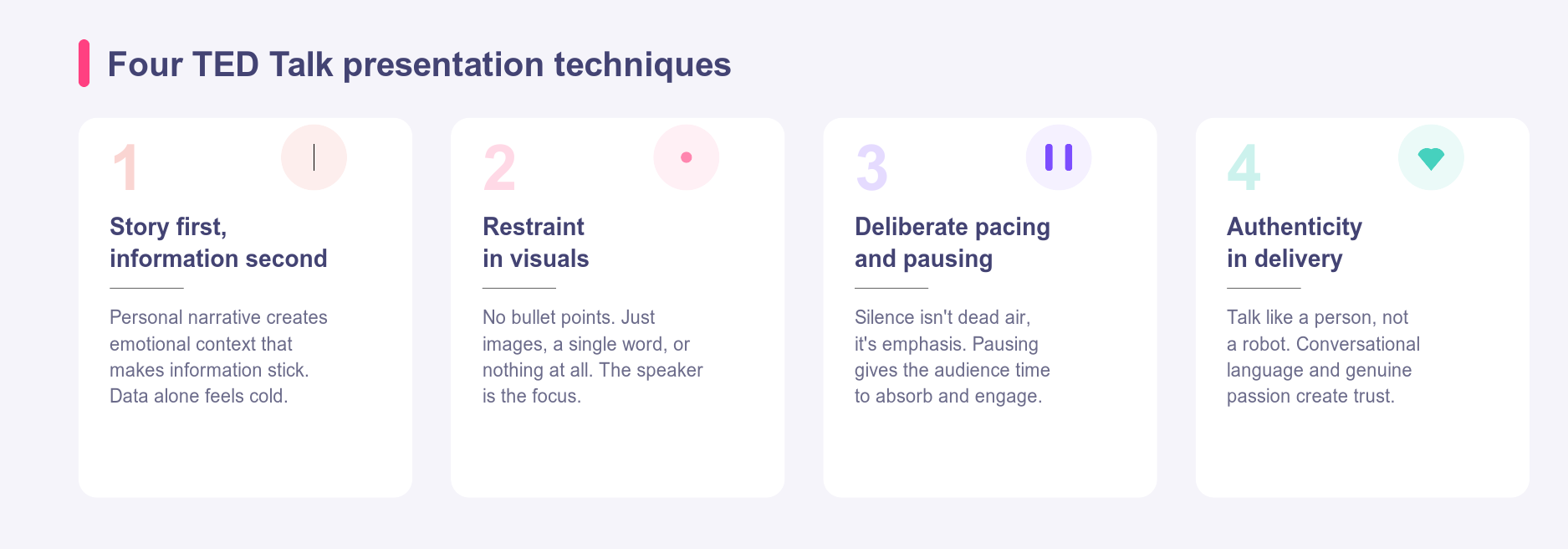
1. Story first, information second
TED speakers don't start with data. They start with a story that makes data matter. "In 2015, malaria cases dropped by 40% because..." is less memorable than "When my daughter got malaria, I didn't understand why a disease that kills millions still lacks funding for prevention."
Personal narrative creates the emotional context that makes information stick. Data alone feels cold.
2. Restraint in visuals
TED Talks rarely show bullet points. Their slides contain visuals, sometimes just a single word, or nothing at all. The speaker is the focus, not the slides.
This works because the speaker's energy and voice carry the presentation. When you have less visual distraction, audience attention focuses on the message itself.
Most corporate presentations do the opposite: they pile information onto slides and the speaker becomes secondary. TED reversed that.
3. Deliberate pacing and pausing
TED speakers don't rush. They pause after big ideas. They pause for audience reactions. Silence isn't dead air; it's emphasis.
Pausing does several things: it gives the audience time to absorb what you said, it breaks up the monotony of constant talking, and it lets you catch your breath and think about what comes next.
The goal is removing the barrier between speaker and audience. When people can think, they engage.
4. Authenticity in 交貨
TED speakers talk like people, not like robots reading a script. They use conversational language. They occasionally stumble. They show genuine passion for their ideas.
This authenticity creates trust. Audiences believe speakers who seem like they're sharing, not lecturing.
TED Talk anatomy: Real example breakdown
Let's look at how a real TED Talk uses this structure. Consider Brené Brown's "The Power of Vulnerability" (20 minutes, but close to the TED format):
Opening story (3 minutes): She shares her research discovery: people with strong connections had one thing in common. They believed they were worthy of connection.
Problem identification (3 minutes): We live in a culture of scarcity and "never enough." We protect ourselves through armor rather than vulnerability.
Deep dive (10 minutes): She shares stories from her research and her own experience. Each story illustrates a specific aspect of vulnerability: shame, imperfection, the courage it takes to be seen.
Insight and call to action (3 minutes): Vulnerability is strength, not weakness. The solution isn't to become tougher; it's to embrace imperfection.
Closing (1 minute): She circles back to her opening about connection, now with new understanding.
Notice that she's not trying to teach vulnerability in a technical sense. She's making an idea come alive through narrative. That's why it resonates.
How to adapt TED Talk technique to your presentations
Start with a story
Don't open with your thesis. Open with an anecdote, a surprising statistic, or a question that makes people curious. The story should be relevant to your main idea but shouldn't state it yet.
Develop one core idea
TED speakers don't try to cover everything. Pick one core idea and develop it thoroughly. If you have supporting ideas, they're in service of that central point.
Use visual restraint
Your slides should amplify your words, not duplicate them. If you're talking about innovation, show a relevant image. Don't show text that says "Innovation" while you talk about innovation.
Better yet, consider using fewer slides. Some of the most effective TED presenters use minimal visuals and let the 技術 itself carry the message. This forces you to organize your ideas clearly before you design anything.
Build in interaction for live presentations
TED Talks are monologues, but your presentation might benefit from audience interaction. If you're presenting live, use 互動 polls or questions to break up the presentation and gather feedback.
Practice deliberate pacing
Record yourself and listen for spots where you're rushing. Slow down. Let important ideas breathe. Pause for audience reactions. This takes practice, but it transforms how your audience receives your message.
What makes a TED Talk resonate
It's not the length. It's not the venue. It's the clarity of thought and the authenticity of delivery. TED Talks work because speakers have a clear idea they want to share and they've developed it fully enough to make it matter.
Your presentation doesn't have to happen on a red circle in Vancouver. But it can follow the same principles: start with story, develop one idea thoroughly, use restraint with visuals, and deliver with authenticity.