
10 Best Public Speaking Tips for Confident, Effective Presentations

部落格縮圖

The difference between a forgettable presentation and one that resonates comes down to preparation and technique. Whether you're presenting to your team, pitching to potential clients, or speaking at a conference, these 10 tips will help you deliver with confidence and impact.

We've compiled the strategies that work across different presentation contexts. Apply these consistently, and you'll see immediate improvements in how audiences respond to your talks.


準備階段

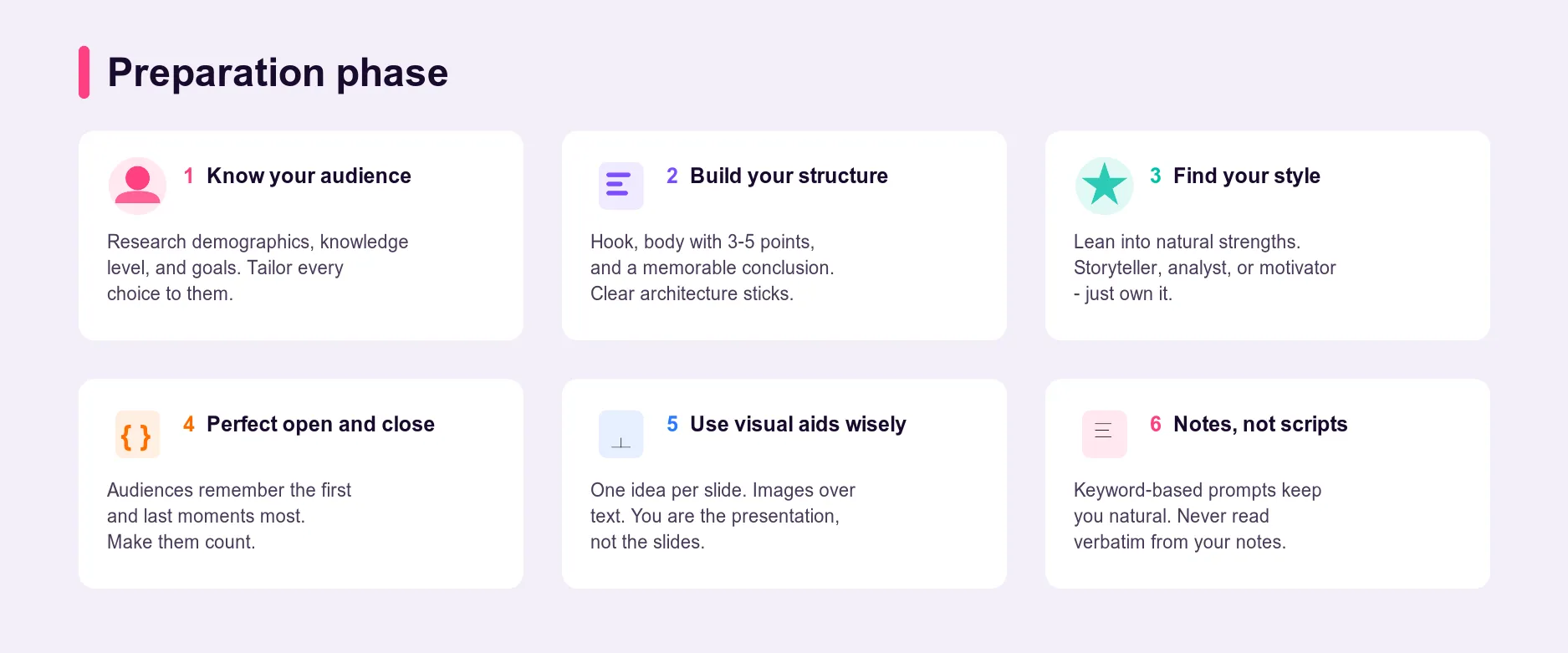
1. 了解您的受眾 內外

The foundation of every effective presentation is understanding exactly who you're addressing. Before you write a single slide, research your audience's demographics, professional backgrounds, knowledge level, and what they hope to gain from your talk.

Ask yourself these questions: What does this audience already know about my topic? What problems do they face that my presentation can address? What language, examples, and references will resonate with them specifically? Are they attending because they want to be there or because they feel obligated?

This information shapes every choice you make about content, tone, and depth. A presentation on data analytics looks completely different when you're speaking to executives versus data scientists versus business owners new to analytics.

When you tailor content to your specific audience, engagement skyrockets. You're not delivering a generic talk; you're having a conversation with them about what they care about.

2. Build your structure 故意地

Random content doesn't stick. Your presentation needs a clear architecture that guides the audience from introduction through conclusion.

Use this proven structure:

  • Introduction (2 minutes or less). Hook the audience with a relevant question, surprising statistic, or personal story. Establish your credibility by explaining why you're qualified to speak on this topic. State what the audience will learn or gain.
  • Body (approximately 15 minutes for a standard talk). Present your main ideas in logical sequence. Aim for three to five core points, not a dozen scattered concepts. Each point should support your overall message.
  • Conclusion (1-2 minutes). Summarize your key takeaways without simply repeating verbatim. End with a memorable closing: an actionable insight, an inspirational thought, or a clear call to action.

This structure works because it respects how people absorb information. They need context (why should I listen?), substantive content (what's the insight?), and reinforcement (what do I do with this?).

3. Find and project your authentic speaking style

Some speakers naturally energize a room. Others excel at building trust through calm, measured delivery. Neither is "better"; they're just different styles, and your effectiveness depends on aligning your style with your content and personality.

Consider what feels natural to you. Are you a natural storyteller who builds connections through narratives? A straight shooter who excels at clarity and data? A motivator who inspires through passion? An analytical guide who walks people through complex problems step by step?

Don't try to be someone you're not. An introvert trying to perform like an extroverted comedian comes across as inauthentic. Leaning into your actual strengths builds credibility and makes your message more convincing.

Watch yourself on video to understand your natural patterns. Then lean into what works rather than fighting against your personality.

4. Perfect your opening and closing

People remember the beginning and end of presentations more than the middle. These bookends deserve dedicated attention.

Your opening should accomplish three things: capture attention, establish relevance, and signal credibility. Open with something unexpected. Don't begin with "Hi, I'm here to talk about X." Instead, start with a question that makes people think, a surprising statistic that challenges assumptions, or a brief personal story that illustrates why this topic matters.

Your closing should reinforce your core message without rehashing it. Leave the audience with something they can act on or remember. A thought-provoking question, an inspiring quote, a clear next step, or a memorable image all serve as strong closings.

Practice your opening and closing until they feel natural. These moments should feel like conversations, not recitations.

5. 合併 視覺輔助 戰略性

Slides should enhance your talk, not replace you. When you use visuals effectively, audiences absorb and retain information better. Data, charts, graphs, photographs, and videos all communicate complex ideas faster than words alone.

However, slides crammed with text become distracting. Each slide should convey a single core idea. Use images that reinforce your point rather than generic stock photos. When displaying data, highlight the insight you're drawing from it rather than showing raw numbers and expecting the audience to interpret.

AhaSlides lets you add interactive elements like polls and quizzes to your presentation. These keep audiences engaged and give you real-time feedback on how well your message is landing.

Remember: you are the presentation. Slides are supporting materials, not the main event.

6. Prepare notes that support, not script

Reading directly from notes or slides undermines your credibility and disconnects you from the audience. At the same time, memorizing everything creates anxiety and rigid delivery.

The sweet spot is keyword-based notes. Write down the core idea for each section, transition phrases, statistics you want to cite accurately, and any jokes or stories you're telling. Use numbered points on small index cards so you can glance at them without getting lost.

These notes remind you what to say without tempting you to read them verbatim. Practice with your notes until you can deliver smoothly while occasionally checking them.


Delivery techniques

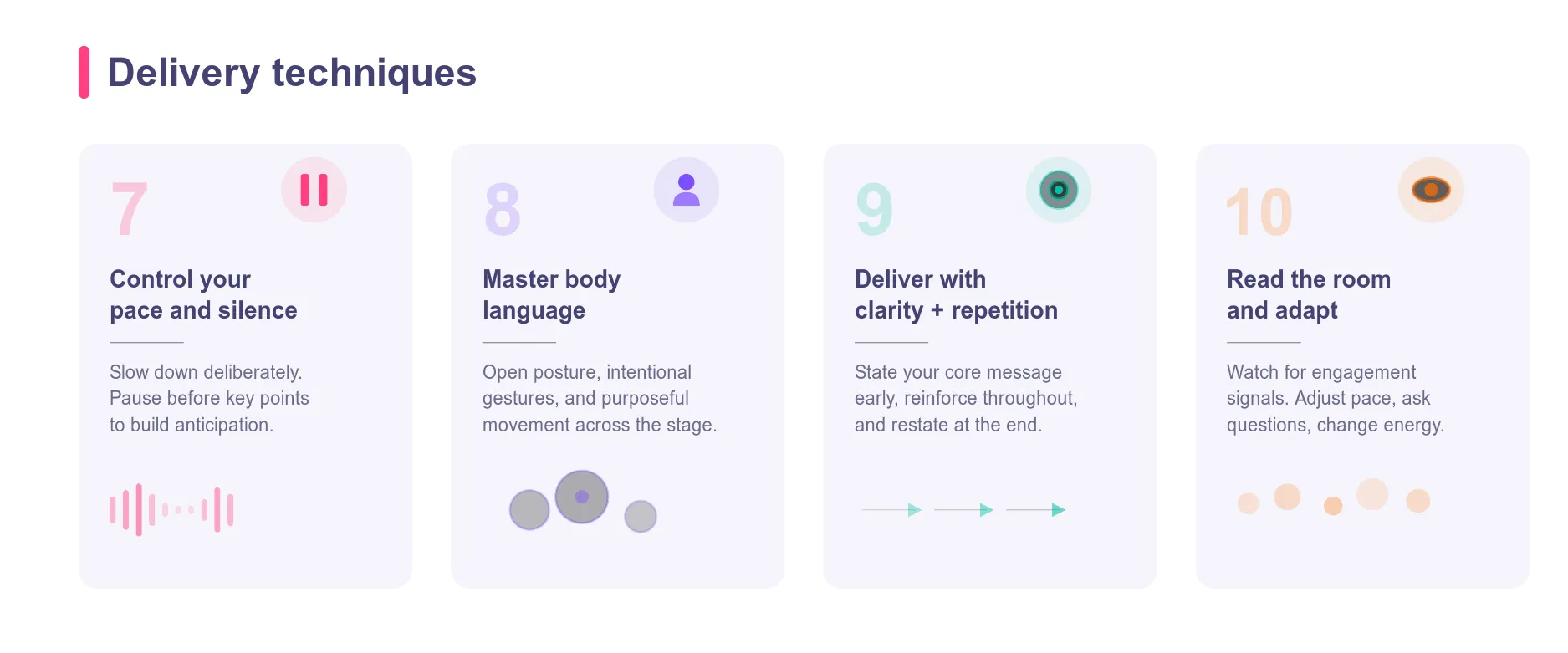
7. Control your pace and use strategic silence

Nervousness causes most speakers to rush. Fast delivery makes the audience work to keep up, misses key points, and broadcasts anxiety.

Deliberately slow down. Leave space between ideas for the audience to absorb. Pause before key points to build anticipation. Pause after important statements to let them sink in.

Silence feels uncomfortable to speakers but powerful to audiences. A three-second pause feels like an eternity to you but gives listeners time to process and actually makes you appear more confident and thoughtful.

Pacing also shows respect for your audience's time. They appreciate a speaker who moves through content with intention rather than racing to cover everything.

8. Master your body language and movement

Your body communicates before your words do. Maintain open posture: shoulders back, chest open, arms visible. Avoid crossing your arms, which creates a defensive barrier, or keeping hands in pockets, which makes you seem uncertain.

Make intentional gestures that support your words. A hand movement that emphasizes a point is natural and engaging. Repetitive nervous gestures (pacing back and forth, playing with keys, tapping the podium) distract from your message.

Vary your eye contact across the room. Look at different audience sections rather than staring at one person or looking down. Eye contact creates connection and signals confidence.

Movement should have purpose. Moving closer to the audience during an important point feels intimate and engaging. Pacing nervously back and forth signals anxiety.

9. Deliver your core message with clarity and repetition

People don't remember everything you say. They remember the main point if you emphasize it clearly and repeat it throughout your talk.

State your core message in the introduction. Reinforce it through examples and evidence in the body. Restate it in the conclusion. This repetition isn't boring; it's how retention works.

Use varied language so the repetition doesn't feel mechanical. The core idea stays consistent, but you illustrate it through different stories, data points, and examples.

10. Read the room and adapt dynamically

Great presentations aren't rigidly scripted. They respond to the audience in the moment.

Watch for signs of engagement or disconnection. Are people leaning in and nodding, or slumping back and looking at phones? If you notice dropping engagement, adjust. Ask a question that requires audience participation. Move closer to the audience. Tell a story. Change your tone or pace. These micro-adjustments reignite attention.

If someone asks a question that derails you, decide quickly whether to address it now or note it for later. Flexibility shows confidence and respect for the audience's interests.

If you stumble over words or lose your train of thought, pause, take a breath, and continue. The audience will forget the mistake almost immediately if you don't dwell on it.


Practice strategies that work

These 10 tips only work if you actually practice them. Here's how to prepare effectively:

  • Rehearse on the actual stage if possible. Familiar environments reduce anxiety. You'll know how your voice carries, how bright the lights are, and how the space feels.
  • Record yourself. Video feedback reveals speaking patterns you can't hear as you're performing. You'll spot filler words, monotone sections, and nervous habits to address.
  • Present to a small group and gather honest feedback. Ask what landed most powerfully, what confused them, and where they tuned out. Use this input to refine your content and delivery.
  • Choose what to wear intentionally. You should feel confident in your outfit, and it should match the formality of the occasion. You'll present better when you're not worrying about how you look.
  • Refine based on each practice run. Each rehearsal should build on the last. Mark what worked, what didn't, and what to adjust next time.

The goal of practice isn't perfection; it's familiarity and confidence. When you've run through your presentation multiple times, you're free to focus on connecting with your audience rather than worrying about what comes next.


全部放在一起

Public speaking effectiveness comes from understanding your audience, structuring your message logically, preparing your content thoroughly, and delivering with confidence. These 10 tips form a complete framework from preparation through delivery.

Start by auditing your next presentation against these points. Which areas are you already strong in? Where could you improve? Pick one or two tips to focus on for your next talk, then add more as those become natural.

Over time, these practices become habitual. You'll spend less energy worrying about technique and more energy connecting with your audience, which is exactly where your focus should be.

訂閱即可獲得提升觀眾參與度的技巧、見解和策略。
謝謝! 您的提交已收到!
糟糕! 提交表格時出了點問題。

查看其他帖子

AhaSlides 已被福布斯美國 500 大企業所採用。立即體驗互動的力量。

了解更多
© 2026 AhaSlides 私人有限公司