



The best post-event survey questions cover five areas: overall experience rating, session content quality, logistics, networking value, and likelihood to attend again. An NPS-style rating question works best at the top to anchor the survey; session content questions for identifying which speakers or topics to repeat or cut; logistics questions for surfacing friction (registration, venue, catering) that affects overall perception; networking questions for measuring whether attendees achieved their primary reason for attending; and a likelihood-to-return question for predicting registration conversion for future events. Send post-event surveys within 24 hours — response rates average 40–60% when sent that day and drop to 20–30% after 48 hours. Keep the survey to 5–7 questions maximum.
The event is over. Attendees have left. Now comes the part that separates organizers who improve from those who guess: collecting feedback. Post-event surveys tell you what worked, what fell flat, and what to change next time, but only if the survey itself is well designed. A vague survey produces vague data.
SurveyMonkey's research on survey length found that completion rates drop to 5-20% for surveys that take longer than 7-8 minutes to complete [1]. That means the questions you include need to earn their place. This guide covers 30+ post-event survey questions organized by what they measure, plus practical guidance on timing, format, and the mistakes that kill response rates.
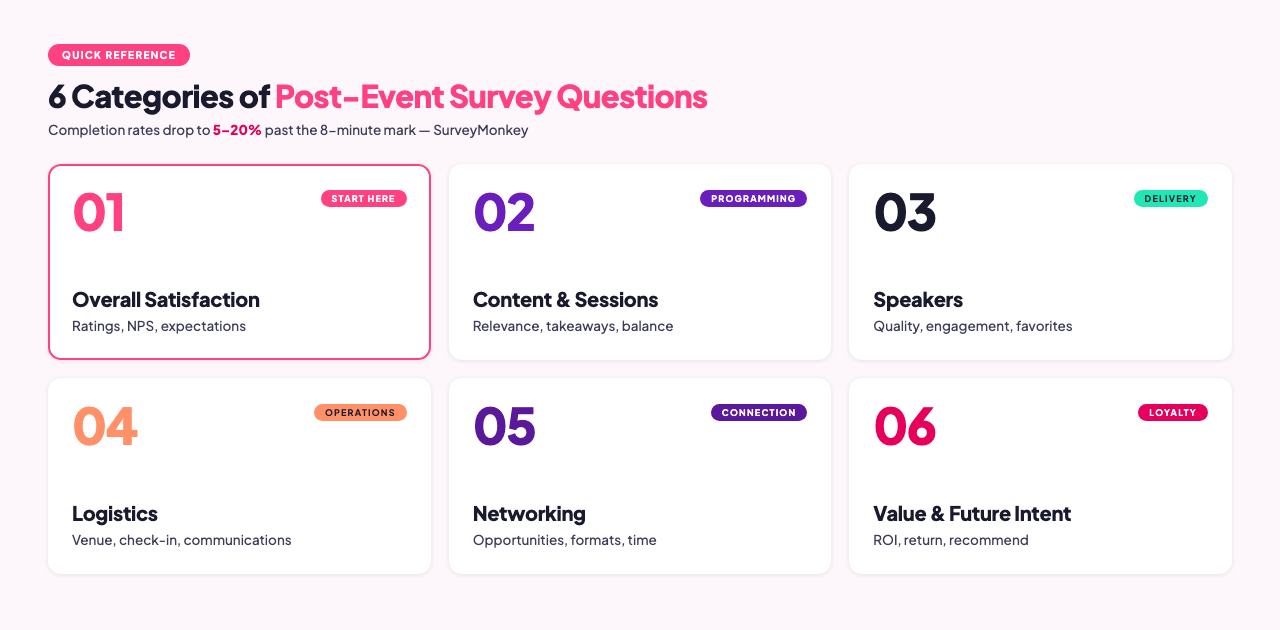
Overall satisfaction
Start broad before going specific. These questions give you a high-level read on how the event landed before you dig into the details.
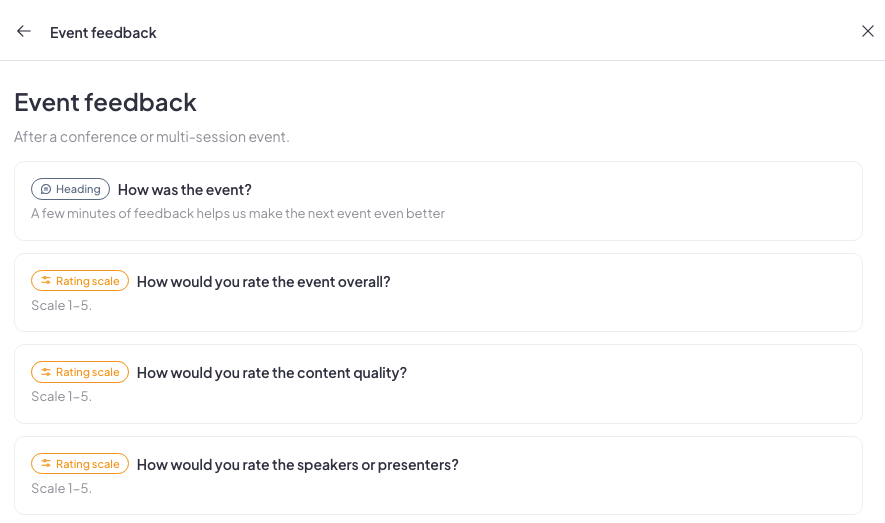
- How would you rate your overall experience at the event? (1-5)
- Did the event meet your expectations? (Exceeded / Met / Fell short)
- How likely are you to attend a future event from this organizer? (Very unlikely to Very likely)
- How likely are you to recommend this event to a colleague? (0-10 NPS scale)
- What one word best describes your experience? (Open-ended or word cloud)
Content and sessions
These questions assess whether the programming delivered value and matched what attendees needed.
- How relevant was the content to your professional needs? (Not at all to Extremely)
- Which session did you find most valuable? (Dropdown or open-ended)
- Which session did you find least valuable? (Dropdown or open-ended)
- Was the content pitched at the right level for your expertise? (Too basic / Just right / Too advanced)
- I gained practical insights I can apply in my work. (Strongly disagree to Strongly agree)
Speakers and presenters
- How would you rate the quality of speakers overall? (1-5)
- Which speaker or presenter stood out most? (Open-ended)
- Was there enough opportunity for Q&A with speakers? (Yes / No / Somewhat)
- What topics would you like to see covered at future events? (Open-ended)
Logistics and organization
- How would you rate the event organization overall? (1-5)
- Was the venue appropriate and comfortable? (Yes / No / Partially)
- How would you rate the registration and check-in process? (1-5)
- Were the event communications (schedule, updates, directions) clear and timely? (Yes / No / Partially)
- How would you rate the food and beverage quality? (1-5 or N/A)
Networking and engagement
- Did the event provide adequate networking opportunities? (Yes / No / Somewhat)
- I made valuable professional connections at this event. (Strongly disagree to Strongly agree)
- What format of networking do you prefer? (Structured sessions / Open networking / Both)
Value and future intent

- The event was a good use of my time. (Strongly disagree to Strongly agree)
- The event was worth the price of admission. (Strongly disagree to Strongly agree)
- What would you change about this event? (Open-ended)
- What was the most valuable part of the event? (Open-ended)
- Any additional comments or suggestions? (Open-ended)
Virtual and hybrid events: additional questions

If your event had a virtual or hybrid component, add a handful of questions specific to that experience.
- How would you rate the quality of the virtual platform? (1-5)
- Did you experience any technical issues during the event? (Yes / No)
- How engaging was the virtual experience compared to an in-person event? (Much less / Less / About the same / More)
Frequently asked questions
What are the best post-event survey questions?
The best post-event survey questions are: (1) an overall experience rating (NPS or 1–10 scale), (2) "What was the most valuable part of this event?", (3) "What would you improve for next time?", (4) "How likely are you to attend again?", and (5) one specific logistics question about an aspect you are tracking. This set of five gives you a quantitative benchmark, qualitative insight, retention signal, and operational feedback in under 3 minutes.
When should you send a post-event survey?
Send post-event surveys within 24 hours of the event ending — ideally within 4–6 hours while the experience is still fresh. Response rates average 40–60% when sent same-day and drop to 20–30% after 48 hours. For multi-day events, send a brief end-of-day survey after each day rather than waiting until the event concludes.
What response rate should you expect from a post-event survey?
Post-event surveys sent within 24 hours typically achieve 40–60% response rates — significantly higher than most survey types. Include a direct link (no login required) in the follow-up email. Adding a personal note from the event host increases response rates by 10–15% compared to automated sends.
How do you get honest feedback in a post-event survey?
Use anonymous collection, ask about specifics rather than just overall satisfaction, and include at least one open-ended question. "What would you improve?" consistently produces more candid responses than "What didn't you like?" because it frames feedback as constructive contribution rather than complaint. Avoid asking leading questions like "How much did you enjoy our keynote speaker?"
Mistakes that kill response rates
Asking too many questions. Aim for 10 questions or fewer [3]. Each additional question reduces completion. Cut anything that is nice-to-know rather than need-to-know.
Sending too late. Memory fades quickly. Send your survey within 24 hours of the event, ideally with an in-room prompt at the closing session. SMS surveys sent within two hours of an event end get 32% more completions than those sent later [2]. A follow-up email 3-4 days later can capture another 20-30% of responses from those who missed the first send [3].
Relying only on open-ended questions. Open-ended responses are rich but hard to analyze at scale, and they drag completion rates down. Use rating scales for quantitative data. Limit open-ended questions to one or two per survey.
Ignoring the results. The fastest way to ensure no one fills out your next survey is to collect feedback and never act on it. Share key findings with attendees and tell them what you are changing based on their input. Even a brief recap email builds trust and increases participation in future surveys.
Using leading questions. "How much did you enjoy our amazing keynote?" is not a neutral question. Keep wording objective and avoid embedded assumptions.
Forgetting to segment. VIPs, first-timers, returning attendees, and virtual participants often have different experiences. At minimum, plan for separate analysis of these groups, and consider tailored question sets if your event is large enough to support it.
Tips for writing questions that get honest answers
Even a well-structured survey can produce unreliable data if the individual questions are poorly written. Here are five practical things to check before you send.
Use a consistent scale throughout. Mixing a 1-5 scale in one section with a 1-10 scale in another forces respondents to reset their mental frame every few questions. Pick one scale for all rated items and stick with it. Most event surveys work well with a five-point scale because it is fast to answer and easy to analyze.
Keep questions to one idea each. "How would you rate the quality of the content and the speaker delivery?" is two questions in one. Respondents who loved the content but found the speaker hard to follow have no good answer. Split double-barreled questions into separate items, even if it adds one more row to the survey.
Give respondents an out on questions that may not apply. If you ask about food and beverage at an event where some attendees only attended virtually, include a "Not applicable" option. Forcing someone to rate something they did not experience skews your data and frustrates the respondent.
Avoid jargon and internal terminology. Your team may refer to a particular session as "the afternoon breakout track," but attendees know it by the session title. Use the same language your attendees used when they registered or received the schedule. This is especially relevant for surveys covering multi-day or multi-track events.
Test the survey before sending it. Run through the entire survey yourself, then ask one person outside the planning team to complete it cold. Look for questions that cause hesitation, scales that feel ambiguous, or logic jumps that do not make sense to someone who was not involved in building the survey. What seems obvious to the organizer is often unclear to an attendee answering quickly on a phone.
Keep the mobile experience in mind. The majority of post-event survey responses come from phones, often while attendees are traveling home. Long question text, small tap targets, and multi-column layouts all hurt completion on mobile. Preview your survey on a phone before sending, and trim any question that requires scrolling to read the full text. A survey that works well on a four-inch screen will work well everywhere. If your platform supports it, enable auto-advance after each rating selection so respondents do not have to tap a separate "next" button. This small change alone can meaningfully reduce drop-off on mobile.
Frequently asked questions
How long should a post-event survey be?
Aim for 8-10 questions that take no more than five minutes to complete. The drop-off between a five-minute survey and a ten-minute survey is significant. Prioritize your most important metrics and cut the rest. If you genuinely need more data, consider running two shorter surveys: one immediately after the event covering overall satisfaction, and a second a week later for deeper input from your most engaged attendees. Another useful rule of thumb: if a question does not map to a decision you could realistically make before the next event, cut it. Every extra question you keep is a small tax on every respondent who completes the survey.
Should I offer an incentive for completing the survey?
Incentives can boost response rates, but they can also attract low-quality responses from people who rush through just to get the reward. A better approach is to make the survey easy and short enough that no incentive is needed. If response rates are still low, consider a sweepstakes entry rather than a guaranteed reward, which reduces the incentive to rush. The most effective incentive is telling attendees that their feedback will influence how the next event is run: people respond when they believe their input matters.
What should I do with the results?
Start by calculating your key metrics: overall satisfaction score, NPS, and any specific scores you are tracking year over year. Then read through the open-ended responses looking for themes. Look for patterns, not one-off complaints. Once you have a clear picture, share a summary with your team and, where appropriate, with attendees. A short "here is what you told us and here is what we are changing" email closes the feedback loop and makes it more likely attendees will participate in future surveys. It also helps to track the same core questions from event to event so you can measure progress over time rather than treating each survey as a standalone exercise. Benchmark scores give context that a single data point cannot.
Collecting feedback during the event with AhaSlides
The most effective time to collect feedback is before attendees leave the room. AhaSlides lets you close the session with live slides: rating scales for your quantitative questions, a word cloud to capture the mood of the room, and an open-ended slide for specific suggestions, with results appearing on screen as the room responds. In-room collection is how you reach the 85-95% completion rates cited above, and watching the collective feedback appear on screen gives the session a concrete closing moment.
For the full questionnaire, AhaSlides Surveys turn the post-event survey questions above into a single form that respondents complete on one page and submit once. Reveal it as the final slide of your closing session, then share the same survey as a link or QR code with attendees who left early; they can answer on any device with no account needed.
Sources
[1] SurveyMonkey. How long should a survey be? https://www.surveymonkey.com/curiosity/survey_completion_times/
[2] Explori. What is a good post-event survey response rate? https://www.explori.com/blog/what-is-a-good-post-event-survey-response-rate
[3] ASAE Center. 5 best practices for creating and sharing post-event surveys. (September 2024) https://www.asaecenter.org/resources/articles/an_plus/2024/09-september/5-best-practices-for-creating-and-sharing-post-event-surveys
For the full survey creation process from objective-setting to analysis, see: How to create an online survey: the complete guide.